Why "data-driven" organizations fail when they deploy AI agents
- Published
- Data
- 16 production engineering studies across 7 repositories, 43 ISO/IEC 42001 controls, 37 SQL freshness contracts, 53 MCP tools, and 787 audited agent runs
- Figures
- 3
The claim
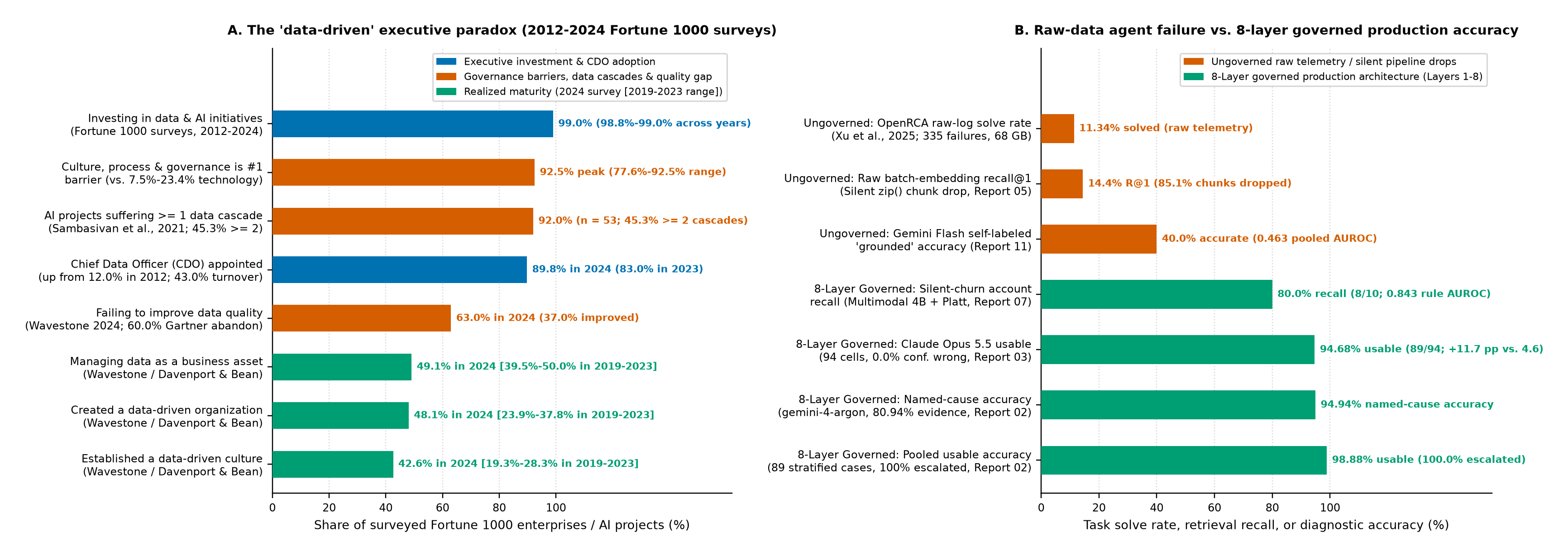
Although we live in the age of data and almost every enterprise calls itself "data-first" and "data-driven," that is rarely true in practice. Across 12 annual Fortune 1000 surveys from 2012 to 2024, 98.8% to 99.0% of enterprises invested in data and AI (Bean & Davenport, 2019). By 2024, 89.8% had appointed a Chief Data Officer, up from 12.0% in 2012 (Davenport & Bean, 2023; Wavestone, 2024).
Yet 77.6% to 92.5% of executives report that culture, process, and governance are their primary bottleneck, compared with 7.5% to 23.4% citing technology. From 2019 to 2023, only 23.9% to 37.8% reported creating a data-driven organization (48.1% in 2024). Even in 2024, 63.0% failed to improve data quality (Wavestone, 2024).
Why do organizations believe they are data-driven when their underlying data is fragmented, untyped, or stale? Because human analysts mask broken data governance through unwritten institutional memory. When a billing table, clinical record, or escalation ticket has a silently NULL column, an experienced analyst notices and routes around it.
Autonomous AI agents have no unwritten institutional memory. Interviewing 53 AI practitioners, Sambasivan et al. (2021) found that 92.0% suffered at least 1 upstream data cascade, and 45.3% suffered 2 or more compounding cascades. Across 335 enterprise failures and 68 GB of raw telemetry, frontier models solved only 11.34% of root causes (Xu et al., 2025). Gartner (2025) forecasts that 60.0% of AI projects lacking AI-ready data and governed semantic layers will be abandoned through 2026.
In an enterprise, governed data enables four capabilities:
- A single operational truth across engineering, support, product, finance, and compliance.
- Causal attribution across distributed systems, workflows, and customer touchpoints when incidents occur.
- Calibrated risk and resource decisions grounded in measured base rates rather than executive intuition.
- Verifiable regulatory and customer assurance where every AI decision and SLA commitment resolves to an immutable audit ledger.
As Vice President of Support and Lead Applied AI at YugabyteDB, I lead our ISO/IEC 42001 (2023) AI Management System certification. Across 16 engineering studies, we built and verified the 8 foundational data-governance layers required before AI agents can operate reliably in production. These 8 layers operationalize ISO/IEC 42001 Annex A.7 (A.7.2 to A.7.6), ISO/IEC 5259-1 (2024) to ISO/IEC 5259-5 (2025), and EN 18286 (CEN/CENELEC, 2026). Together, they turn data-governance and Data Mesh principles into executable gates (Khatri & Brown, 2010; Abraham et al., 2019; Dehghani, 2022).
| governance layer | ungoverned enterprise illusion | deterministic engineering control | headline production impact & deep-dive breakout | normative standard mapping |
|---|---|---|---|---|
| 1. Data ownership & decision rights | Appointing a CDO means data is owned; builders can self-approve AI controls | Producer scoping (7 repos, 53 MCP tools) + 304-cell RACI across 3 Lines of Defense + SQL attestation constraint | Audited 104 verification checkpoints; downgraded 28 of 29 (96.6%) unverified LLM "Yes" claims; caught 25.0% mock-only safety tests (report 09) |
ISO/IEC 42001 Cl. 4.1, 5.3, A.3.2, A.7.2; ISO/IEC 5259-5; EN 18286; Khatri & Brown (2010) |
| 2. Canonical definitions & schemas | Logs, metrics, and cost traces have self-evident meanings across teams | 51,954 AST-mined templates + 32 lnav formats + 34-column Schema v8 verified by 1,368 LOC of Lean 4 (9,623 LOC suite) |
Killed 100.0% (72 of 72) of semantic mutants; reached 100.0% coverage across 8.31M public Zenodo records (reports 06, 08, 16) | ISO/IEC 42001 Cl. 9.1, A.6.2.4, A.7.2; ISO/IEC 5259-1 & 5259-2; ISO/IEC 22989 |
| 3. Enforced data quality gates | If ETL cron jobs exit with HTTP 200, the data feeding AI is healthy |
37 SQL freshness/completeness contracts + batch cardinality assertions + 0.4 quality floor + 0.85 cosine dedup | Caught 1,546 NULL escalations behind 1,023 green runs; stopped 85.1% silent vector drops for +58.2 pp recall@1 (reports 05, 10, 15) |
ISO/IEC 42001 A.7.3, A.7.4, A.7.6; ISO/IEC 5259-2 to 5259-4; EU AI Act Art. 10 & 15(4) |
| 4. Typed operational metadata | Vector similarity over raw text eliminates the need for structured metadata | 10 typed entity columns + 11 calibrated Bloom filters + embedding_version = 2 stamps + STALE note markers |
Caught 99.12% (2.13M) drifted vectors; cut Bloom index overhead 94.7%; sped up tail-quantile SQL 1,057.0x (reports 06, 10, 16) | ISO/IEC 42001 A.7.4, A.7.5, A.8.2; ISO/IEC 5259-2 & 5259-3; Abraham et al. (2019) |
| 5. Cryptographic lineage & ledgers | An LLM's verbalized confidence score and markdown links prove its answer | BLAKE3/SHA-256 provenance + 365-day trace retention + 3-tier Grounded/Supported/Inconclusive gate |
Downgraded 87.7% of raw Grounded claims to 97.1% (33 of 34) badge precision (0.0% conf. wrong); +26.0 pt AUROC (reports 01, 03, 11) |
ISO/IEC 42001 Cl. 7.5.3, A.6.2.8, A.7.5; EN 18286; EU AI Act Arts. 12 & 14; Xiong et al. (2024) |
| 6. Governed semantic layers | Agents can run raw Text-to-SQL or ripgrep and weigh base rates in prompts |
53 governed MCP tools + SQL privacy views (n < 5 suppression) + external logit fusion + multimodal 4B telemetry |
16.06 ms multi-layer diagnosis (975.5x faster than ripgrep); +44.1 pt AUROC lift (0.402 to 0.843; 0.816 rarity; reports 07, 16) |
ISO/IEC 42001 Cl. 9.1, A.4.3, A.8.2; EU AI Act Annex III 4(b); Gartner (2025) |
| 7. Zero-trust access & redaction | Regex SQL filters and default Cloud DLP safely govern agent tool calls | 3-layer DuckDB C++ AST sandbox + 7-layer read-only DB role + 33-rule redactor & Cloud DLP keep-filter / local 4B Q8_0 |
Blocked 100.0% of SQL escapes; 99.4% secret recall, 99.58% ID preservation (F1 = 0.995), and 0.0% stalls at 29.0 ms (reports 10, 12) |
ISO/IEC 42001 Cl. 6.1.3, A.4.4, A.7.6, A.9.2; EU AI Act Art. 15(5); Khatri & Brown (2010) |
| 8. SLA-backed data products | Dumping raw files into object storage and calling cloud APIs scales linearly | Schema v8 Parquet (k* = 1 at 0.76 s) + 7,182-token briefings (11.38 ms) + Vertex prompt caching + 128 GB local GPU appliance |
2,050x token compression inside L_eff; 71.1% to 74.8% cache cost cut; 7.8x to 242.6x local TCO savings; 98.88% usable accuracy (reports 02, 04, 13, 16) |
ISO/IEC 42001 Cl. 7.1, 8.1, A.4.5, A.7.6; ISO/IEC 5259-4; Dehghani (2022); Hoefler & Belli (2015) |
Why raw enterprise data breaks autonomous AI agents
Khatri & Brown (2010) separated data governance (who holds decision rights across 5 domains) from data management (executing those policies). Reviewing 145 studies, Abraham et al. (2019) showed that governance fails whenever structural accountability, procedural gates, and technical metadata are decoupled. In machine learning systems, Sculley et al. (2015) and Polyzotis et al. (2018) demonstrated that undeclared data dependencies quickly turn into compounding technical debt.
When an enterprise points a frontier model directly at raw operational tables, unparsed logs, and unvetted notes, three failure modes fire immediately.
- Raw telemetry overflows the model's effective reasoning regime (
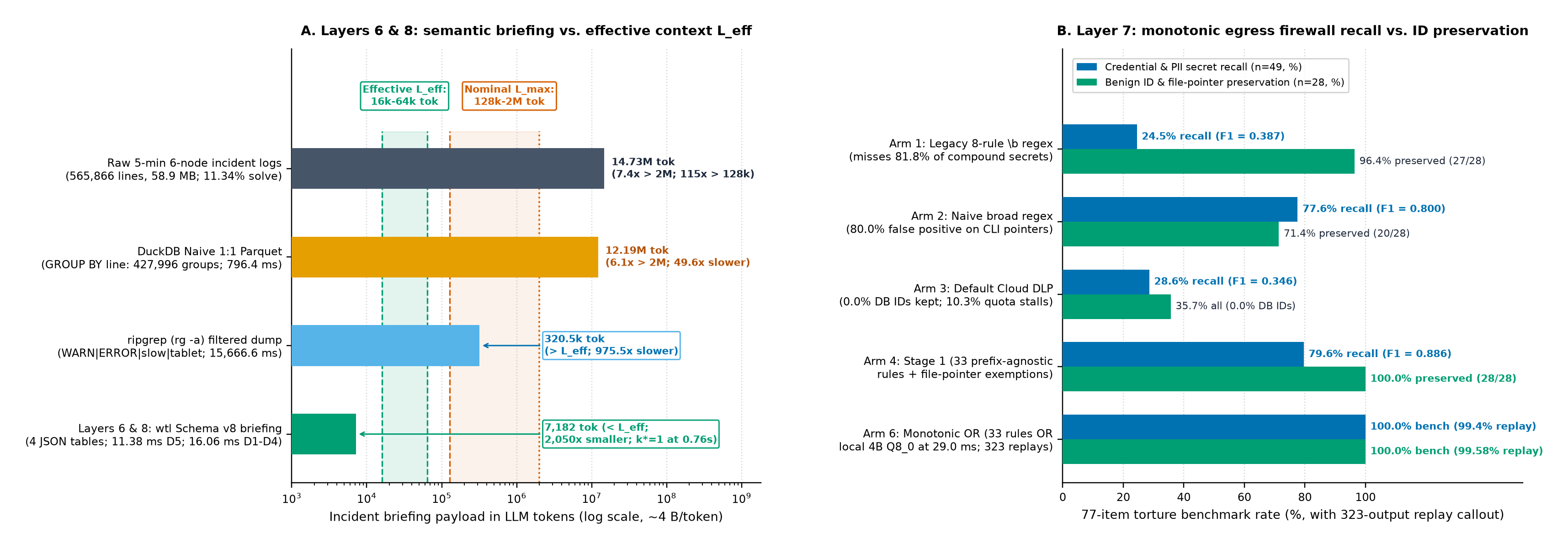
L_eff). Frontier models advertise nominal context windows (L_max) from 128k tokens up to 2M tokens. Across 17 long-context models, the effective reasoning regime (L_eff) is only 16k to 64k tokens (Hsieh et al., 2024; Liu et al., 2024). Input-length reasoning decay also fires well belowL_max(Levy et al., 2024). A single 5-minute, 6-node database incident emits 565,866 lines (58.9 MB, or 14.73M tokens). That payload exceeds a 2M-token window by 7.4x and 128k by 115x (report 16). - Green
HTTP 200ingestion pipelines hide silent data corruption. Standard infrastructure monitoring checks only whether cron jobs exit 0. Behind green status codes, our audits uncovered 99.12% unversioned vector-space drift, 85.1% silent batch-embedding drops, and 1,546NULLed escalation records (report 05, report 10). - Model self-confidence and in-prompt base rates fail under audit. Across 787 forensic runs, model verbalized confidence scored 0.463 AUROC against 0.500 random chance, providing zero usable discrimination signal (Xiong et al., 2024; report 11).
Layers 1 to 4: ownership, canonical definitions, quality gates, and metadata
Layer 1: Data ownership and decision rights (ISO/IEC 42001 Clauses 4 & 5, Annex A.3 & A.7.2)
- The enterprise illusion. Organizations often assume that appointing a Chief Data Officer or calling cloud model APIs exempts engineering teams from formal data ownership. Without segregation of duties, one team builds an AI workflow, approves its risk posture, and grades its security questionnaires (Raji et al., 2020).
- The governance control. Under
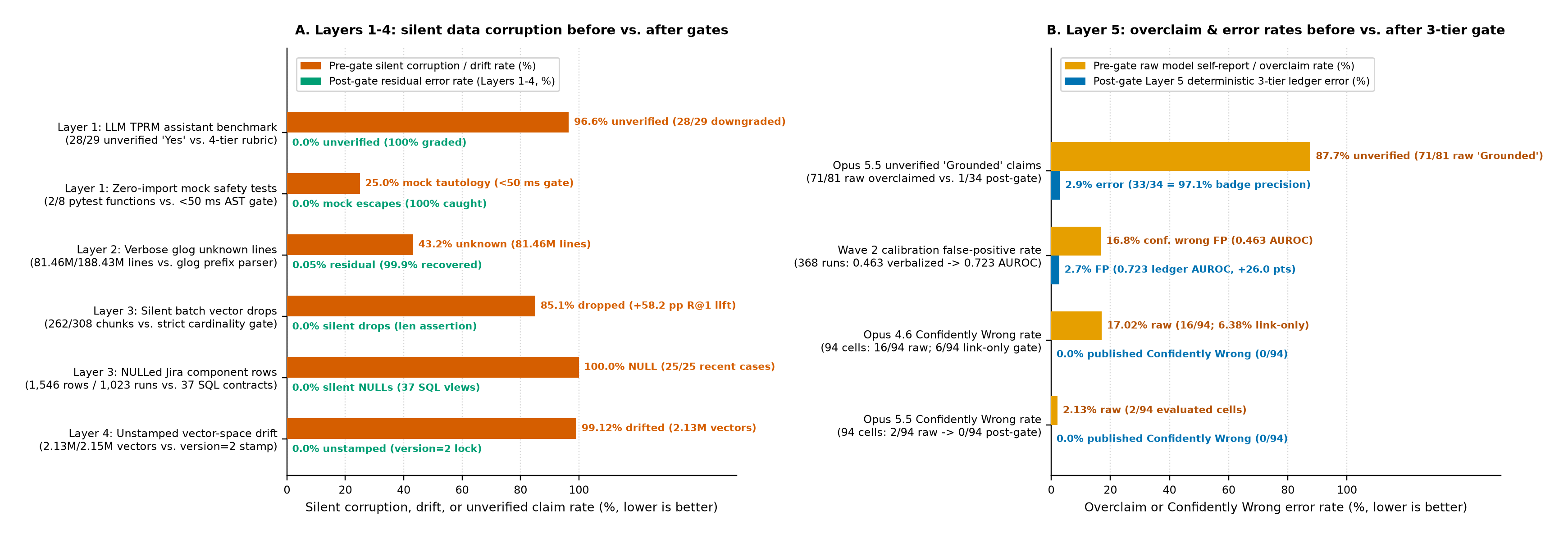
ISO/IEC 42001Clause 4.1,ISO/IEC 22989(2022), andEN 18286(CEN/CENELEC, 2026), operating retrieval pipelines and agent tools makes an enterprise the AI producer (Mökander et al., 2023). Our scope covers 7 repositories, 53 MCP tools, and 14 connectors (4.31M chunks, 43 controls). Across that scope, we enforce a 304-cell RACI matrix (38 activities across 8 roles and 3 Lines of Defense). A PostgreSQLCHECKconstraint also requires a verified evidence URL before any control can be marked met (Brundage et al., 2020). - Production proof and breakout. Enforcing Layer 1 audited 104 verification checkpoints across code and documentation and flagged 2 of 8 (25.0%) mock-only safety tests in under 50 ms. In an offline 31-question security questionnaire benchmark, an unverified LLM assistant marked 29 of 31 answers
"Yes"(93.5%). Our 4-tier evidence rubric downgraded 28 of those 29 claims (96.6%, or 90.3% of all 31 questions; report 09).
Layer 2: Canonical definitions and formal schemas (ISO/IEC 42001 Clause 9.1, ISO/IEC 5259-1 & 5259-2)
- The enterprise illusion. Teams treat log streams, latency counters, and token cost dashboards as self-explanatory. In reality, heuristic parsers (
drain3) achieve only 73.17% Grouping Accuracy on standard benchmarks (Zhu et al., 2023). NaiveGROUP BY lineleaves 70.91% of parameterized templates uncollapsed. Similarly, off-the-shelf tracing overstates agent run costs by 45.0% to 48.0% by mispricing tool payloads and cached reads (report 02, report 04). - The governance control. Our Rust log-to-Parquet engine (
what_the_log,wtl) is currently being prepared for Apache 2.0 open-source release. Inwtl, we mine 51,954 canonical templates from 93,459 AST call sites alongside 32 declarativelnavformats. We verify its 34-column Schema v8 lakehouse in 1,368 lines of Lean 4 (31 theorems, 301 FFI checks). Our Python enum kernel is verified in 1,932 lines within our 9,623-line, 264-theorem formal suite (0sorry). - Production proof and breakout. Formal schema verification killed 72 of 72 (100.0%) semantic data-plane mutants. It also reached 100.0% logical record coverage across all 8,314,141 records in the 1.21 GB (8.54M-line) Zenodo 8196385 suite. On Loghub-16, it achieved 99.69% to 100.0% Grouping Accuracy (report 06, report 08, report 16).
Layer 3: Enforced data quality and cardinality gates (ISO/IEC 42001 Annex A.7.3 to A.7.6, ISO/IEC 5259-3 & 5259-4)
- The enterprise illusion. Data teams equate pipeline health with green job exit codes. When a schema change or SDK quirk truncates records without throwing an exception, RAG indexes degrade silently (Wang & Strong, 1996; Breck et al., 2019).
- The governance control. We enforce 37 PostgreSQL freshness and non-null completeness contracts across all 37 data pipelines alongside boundary cardinality assertions (
len(vectors) == len(texts)). We also apply a 0.4 pre-embedding chunk quality floor, 0.85 cosine semantic deduplication, and EU AI Act Article15(4)feedback-loop blocks excluding AI-generated notes. - Production proof and breakout. Our SQL completeness views caught 1,546
NULLed Jira component rows that had passed unnoticed across 1,023 consecutive green runs (25 of 25 recent escalations, 100.0%). Boundary cardinality assertions stoppedgemini-embedding-2batch calls from silently dropping 85.1% (262 of 308) of document chunks. That fix lifted rank-1 retrieval recall by +58.2 percentage points from 14.4% to 72.6% (report 05, report 10, report 14, report 15).
Layer 4: Typed operational metadata and versioned state (ISO/IEC 42001 Annex A.7.4, A.7.5, A.8.2)
- The enterprise illusion. Organizations assume that dense vector embeddings or full-text search over raw text can replace typed metadata. Without extracted entity keys, cross-node causal joins are impossible; without embedding-version stamps, model upgrades leave millions of vectors stranded in incompatible geometric spaces.
- The governance control. Schema v8 promotes 10 typed entity columns (
tablet_uuid,transaction_id,error_code) and indexes 11 columns with cardinality-calibrated Split-Block Bloom Filters (SBBF). It also pre-computes online Welford and p50/p95/p99 summaries (args_summary), stampsembedding_version = 2on every vector chunk, and attachesSTALEandcoverage.data_missingflags. - Production proof and breakout. Metadata auditing exposed that 99.12% (2.13M of 2.15M) of stored vectors sat in an older embedding space despite 0 ingestion errors. Prefix metadata also recovered 81.36M of 81.46M (43.2% down to 0.05%) unknown verbose log lines. Calibrating Bloom filters cut index overhead by 94.7% (1,130.4 MB to 59.6 MB). Promoted metadata also accelerated tail-quantile SQL 1,057.0x from 5,380.38 ms to 5.09 ms (report 06, report 10, report 16).
Layers 5 to 8: lineage, semantic interfaces, zero-trust access, and data products
Layer 5: Cryptographic lineage and deterministic evidence ledgers (ISO/IEC 42001 Clause 7.5.3, Annex A.6.2.8, A.7.5)
- The enterprise illusion. Teams treat an agent's self-reported confidence score and inline markdown citations as proof of grounding. Across 94
claude-opus-5-5cells, the raw model claimedGroundedstatus on 81 of 94 cells (86.2%). Yet 61 of 94 (64.9%) lacked any resolvable tool link, and 84 of 94 (89.4%) lacked a verified root-cause link. Ongemini-3.8-flash, runs self-labeledgroundedwere accurate only 40.0% of the time. - The governance control. We strip verbalized confidence and verify every draft against a cryptographic tool-call trace ledger (
BLAKE3chunk hashes andSHA-256manifest digests). Under EU AI Act Article 12 andEN 18286, we retain traces for 365 days across 380,730 spans. A deterministic 3-tier gate (Grounded,Supported,Inconclusive) checks link resolution, entity-ID overlap, and differential hypothesis testing before any badge reaches an engineer. - Production proof and breakout. On Opus 5.5 (89 of 94, or 94.68% usable), the 3-tier gate downgraded 71 of 81 (87.7%) overclaimed cells. It issued 34 verified badges (
10 Grounded + 24 Supported) at 97.1% precision (33 of 34 useful, 2.9% error). On Opus 4.6,Confidently Wrongoutputs dropped from 17.02% raw (16 of 94; 6.38% link-only) to 0.0%. On Opus 5.5, they dropped from 2.13% raw (2 of 94) to 0.0%. Across 368 Wave 2 runs, the ledger lifted calibration AUROC +26.0 points from 0.463 to 0.723 (report 01, report 02, report 03, report 11).
Layer 6: Governed semantic layers and tool interfaces (ISO/IEC 42001 Clause 9.1, Annex A.4.3, A.8.2)
- The enterprise illusion. Enterprises assume they can expose raw database schemas or
ripgrepshells to agents and paste historical base rates into prompts. In practice,ripgrepcannot execute multi-node joins, and forcing schema retries causes agent hedging (-6.38 percentage points usable accuracy). Pasting fleet rule firing rates into prompts also triggers the Prior Paradox, collapsing 4B rule-arbitration AUROC to 0.402. - The governance control. Agents query operational data through 53 intent-typed MCP tools backed by Schema v8 Parquet and PostgreSQL semantic views. Those views suppress cohorts with
n < 5to prevent EU AI Act Annex III4(b)worker surveillance. Base rates are fused externally in logit space (0.7 * z_rarity + 0.3 * z_model) rather than inside the prompt. Customer risk scoring also combines text with structured operational telemetry (bundle uploads, comment velocity, entitlement errors) and Platt scaling. - Production proof and breakout. Semantic SQL executes all 4 core distributed diagnostic queries (
D1toD4) in 16.06 ms total. That is 49.6x faster than 796.4 ms naive Parquet and 975.5x faster than 15,666.6 msripgrep. External logit fusion reversed the Prior Paradox by +44.1 AUROC points from 0.402 to 0.843 (with deterministic rarity alone at 0.816). Multimodal 4B telemetry caught 80.0% (8 of 10) of silent-churn accounts. It also cut CSAT false positives by 77.8% to 88.9% from a 76.1% false-discovery baseline (report 03, report 06, report 07, report 09, report 16).
Layer 7: Zero-trust access rights and egress redaction (ISO/IEC 42001 Clause 6.1.3, Annex A.4.4, A.7.6, A.9.2)
- The enterprise illusion. Security teams often rely on regex SQL blocklists, word-boundary (
\b) secret scanners, and default Cloud DLP to guard agent tools. In our tests, regex SQL filters missed 50.0% of path traversals, and legacy\bregexes (Arm 1) missed 81.8% of compound credentials (24.5% recall,F1 = 0.387). Naive broad regexes (Arm 2, 77.6% recall,F1 = 0.800) hit an 80.0% false-positive rate on CLI file pointers (71.4% negative preservation). Unfiltered Cloud DLP (Arm 3, 28.6% recall,F1 = 0.346, 35.7% overall preservation) masked 100.0% (0.0% kept) of database IDs. It also stalled for 57 to 59 s on 10.3% of calls. - The governance control. We enforce a 3-layer DuckDB C++ AST sandbox (
SET lock_configuration = true), a 7-layer read-only PostgreSQL role, a 20-tool intake allowlist, and AST-verifiedpublic=Falsepublishing locks. In live production, customer telemetry stays strictly inside regional cloud boundaries. There, 33 prefix-agnostic rules (Arm 4: 79.6% recall,F1 = 0.886, 100.0% negative preservation across 28 benign IDs) pair with regional Cloud DLP and a 32-charactertechnical_contextkeep-filter. We also evaluated a two-stage monotonicORfirewall (Arm 6: 33 rulesORa local 8-bitQ8_04B model at 29.0 ms). Customer production telemetry never touches the local 128 GB GPU workstation. - Production proof and breakout. AST sandboxing blocked 100.0% of SQL escapes. On the 77-item torture benchmark, the monotonic
ORfirewall (Arm 6) achieved 100.0% secret recall and 100.0% negative preservation. Across 323 replayed MCP tool outputs, it reached 99.4% recall and 99.58% negative preservation (0.42% FPR,F1 = 0.995). It also achieved 0.0% quota stalls at 2,000x faster kernel latency than Cloud DLP (report 09, report 10, report 11, report 12).
Layer 8: SLA-backed data products for humans and AI agents (ISO/IEC 42001 Clauses 7.1 & 8.1, ISO/IEC 5259-4, Dehghani, 2022)
- The enterprise illusion. Dumping raw telemetry into object storage and running uncached multi-turn agent loops fails both context and cost budgets. A 5-minute raw log window (14.73M tokens) or naive Parquet table (427,996 groups, 12.19M tokens) exceeds 2M
L_maxby 6.1x to 7.4x. Neither payload fits insideL_eff(16k to 64k). Meanwhile, running high-rejection pre-release verification loops (63.04B tokens across 2,580 sessions) on uncached cloud APIs would cost $191.4k to $957.0k. - The governance control. We package telemetry into SLA-backed data products (Dehghani, 2022; Hoefler & Belli, 2015). These include a Schema v8 Parquet lakehouse (
k* = 1break-even at 0.76 s) and a 4-table JSON briefing generated in 11.38 ms. We pair those products with Vertex AI prompt-cache breakpoints in regional cloud production. For offline pre-release verification loops, we run a co-resident 128 GB local GPU appliance ($3,945/yr TCO). - Production proof and breakout. Our Schema v8 agent briefing compresses 565,866 incident log lines (14.73M tokens) by 2,050x into 7,182 tokens. That payload sits inside the 16k to 64k
L_effregime on every model (74.2x to 88.4x token reduction across 25 production queries). Explicit prompt caching cut cloud multi-turn cost by 71.1% to 74.8%, and local GPU verification saved 7.8x to 242.6x in TCO with 0HTTP 429stalls. Operating on top of all 8 layers, our agents achieved 98.88% pooled usable accuracy across 89 stratified incidents. On escalated incidents, they reached 100.0% usable accuracy, 94.94% named-cause accuracy, and 80.94% evidence recovery (report 02, report 04, report 06, report 13). Full chaos and Pareto benchmarks appear in report 15 and report 16.
Governance antipatterns rejected by our gates
- Connecting frontier agents directly to raw logs or unmodeled tables. Rejected because 14.73M raw incident tokens exceed
L_maxby 7.4x and leave raw-log RCA accuracy at 11.34% (Xu et al., 2025). - Equating
HTTP 200job exit codes with data quality. Rejected after SQL and cardinality gates caught 1,546NULLed escalations, 85.1% silent batch vector drops, and 99.12% drifted vectors. - Trusting verbalized confidence or in-prompt base rates. Rejected after verbalized confidence scored 0.463 AUROC and in-prompt base rates collapsed 4B AUROC to 0.402 versus 0.843 with external logit fusion.
- Relying on regex SQL filters or unfiltered Cloud DLP. Rejected after regex missed 50.0% of path traversals and 81.8% of compound secrets while unfiltered Cloud DLP masked 100.0% of database IDs.
Pressure tests
Every finding was checked against the six standing fronts in Methods.
| front | what was tested | result |
|---|---|---|
| Specification | Direct raw-data prompting (L_max = 128k to 2M) vs 8-layer governed architecture targeting L_eff (16k to 64k) |
Compressing 14.73M raw incident tokens into a 7,182-token Schema v8 briefing (11.38 ms) inside L_eff enables 98.88% usable accuracy |
| Aggregation | Whole-pipeline green cron exit codes (HTTP 200) vs per-column SQL contracts and boundary cardinality assertions |
Exposed 1,546 NULLed escalations behind 1,023 green runs and stopped 85.1% batch vector drops (+58.2 pp rank-1 recall lift) |
| Adjustment coarseness | Uncalibrated verbalized confidence (0.463 AUROC) and raw Grounded claims (86.2%) vs 3-tier deterministic evidence ledger |
Downgraded 87.7% (71 of 81) overclaims to 97.1% (33 of 34) badge precision (0.0% conf. wrong) and lifted AUROC +26.0 pts to 0.723 |
| Prior work | Fortune 1000 CDO surveys (Bean & Davenport, 2019; Davenport & Bean, 2023; Wavestone, 2024), Data Cascades (Sambasivan et al., 2021), and Data Governance / Mesh (Khatri & Brown, 2010; Abraham et al., 2019; Dehghani, 2022) | Operationalized across ISO/IEC 42001 (2023) Annex A.7 (A.7.2 to A.7.6), ISO/IEC 5259-1 to 5259-5, and EN 18286 (2026) with executable code and SQL gates |
| Baseline sufficiency | Legacy \b regexes (24.5% recall) and default Cloud DLP (28.6% recall, 0.0% DB IDs kept, 10.3% stalls) vs 2-stage monotonic firewall |
33 prefix-agnostic rules OR local 4B Q8_0 model (29.0 ms) achieved 99.4% recall, 99.58% negative preservation (F1 = 0.995), and 0.0% stalls |
| Cross-sectional units | 89 stratified incidents, 787 forensic runs, 323 MCP outputs, and 12 public Zenodo systems (1.21 GB, 8.54M lines; Zhu et al., 2023) | Consistent governance enforcement, 100.0% Zenodo logical record coverage, and 6 regressing releases blocked in CI |
What this does not show
First, building all 8 data-governance layers does not make foundation models infallible reasoners. Even when consuming a governed 7,182-token briefing, models still propose unverified hypotheses on novel failure modes. Our 0.0% published Confidently Wrong rate on Opus 4.6 and Opus 5.5 holds because Layer 5 downgrades 87.7% of unverified Grounded claims before publication.
Second, automated engineering gates (Layers 2 through 8) cannot replace human executive accountability in Layer 1. Across 12 years of Fortune 1000 surveys, 77.6% to 92.5% of data bottlenecks stem from organizational alignment and decision rights (Bean & Davenport, 2019). Longitudinal follow-ups through 2024 confirm that pattern (Davenport & Bean, 2023; Wavestone, 2024). Structural RACI checks and SQL constraints enforce segregation of duties, but leadership must still uphold human override authority (Annex A.9.2) and independent external certification audits.
Third, our specific templates (51,954 AST-mined templates) and redaction rules (33 prefix-agnostic rules) are calibrated on distributed database and cloud operations. Even so, the 8-layer governance architecture is domain-agnostic. Banking, healthcare, telecom, and SaaS organizations must calibrate their Layer 2 schemas and Layer 7 keep-filters on their own domain entities.
Reproduce
All aggregate metrics in this report and its three figures are stored in numbers.json and verified against MANIFEST.md. Full experimental protocols are documented in Reports 01 through 16.
References
- Abraham, R., Schneider, J., & vom Brocke, J. (2019). Data Governance: A Conceptual Framework, Structured Review, and Research Agenda. International Journal of Information Management. DOI.
- Bean, R., & Davenport, T. H. (2019). Companies Are Failing in Their Efforts to Become Data-Driven. Harvard Business Review.
- Breck, E., Polyzotis, N., Roy, S., Whang, S., & Zinkevich, M. (2019). Data Validation for Machine Learning. Proceedings of MLSys 2019.
- Brundage, M., Avin, S., Wang, J., Belfield, H., Krueger, G., Hadfield, G., et al. (2020). Toward Trustworthy AI Development: Mechanisms for Supporting Verifiable Claims. arXiv preprint. arXiv.
- CEN/CENELEC. (2026).
EN 18286: Artificial Intelligence - Quality Management System for EU AI Act Regulatory Purposes. European Committee for Standardization. - Davenport, T. H., & Bean, R. (2023). Action and Inaction on Data, Analytics, and AI. MIT Sloan Management Review.
- Dehghani, Z. (2022). Data Mesh: Delivering Data-Driven Value at Scale. O'Reilly Media.
- European Parliament & Council of the European Union. (2024). Regulation (EU) 2024/1689 Laying Down Harmonised Rules on Artificial Intelligence (Artificial Intelligence Act). Official Journal of the European Union.
- Gartner. (2025). Lack of AI-Ready Data Puts AI Projects at Risk (Gartner Predicts 60% of AI Projects Will Be Abandoned Through 2026). Gartner Research.
- Hoefler, T., & Belli, R. (2015). Scientific Benchmarking of Parallel Computing Systems: Twelve Ways to Tell the Masses When Reporting Performance Results. Proceedings of ACM/IEEE SC 2015. DOI.
- Hsieh, C.-P., Sun, S., Kriman, S., Acharya, S., Rekesh, D., Jia, F., Zhang, Y., & Ginsburg, B. (2024). RULER: What's the Real Context Size of Your Long-Context Language Models? Proceedings of COLM 2024. arXiv.
- ISO/IEC. (2022).
ISO/IEC 22989(2022): Information Technology - Artificial Intelligence - Artificial Intelligence Concepts and Terminology. International Organization for Standardization. - ISO/IEC. (2023).
ISO/IEC 42001(2023): Information Technology - Artificial Intelligence - Management System. International Organization for Standardization. - ISO/IEC. (2024).
ISO/IEC 5259-1(2024) toISO/IEC 5259-5(2025): Artificial Intelligence - Data Quality for Analytics and Machine Learning (ML), Parts 1 to 5. International Organization for Standardization. - Khatri, V., & Brown, C. V. (2010). Designing Data Governance. Communications of the ACM. DOI.
- Levy, M., Jacoby, A., & Goldberg, Y. (2024). Same Task, More Tokens: the Impact of Input Length on the Reasoning Performance of Large Language Models. Proceedings of ACL 2024. arXiv.
- Liu, N. F., Lin, K., Hewitt, J., Paranjape, A., Bevilacqua, M., Petroni, F., & Liang, P. (2024). Lost in the Middle: How Language Models Use Long Contexts. Transactions of the Association for Computational Linguistics. DOI.
- Mökander, J., Schuett, J., Kirk, H. R., & Floridi, L. (2023). Auditing Large Language Models: A Three-Layered Approach. AI and Ethics. DOI.
- Polyzotis, N., Roy, S., Whang, S. E., & Zinkevich, M. (2018). Data Lifecycle Challenges in Production Machine Learning: A Survey. ACM SIGMOD Record. DOI.
- Raji, I. D., Smart, A., White, R. N., Mitchell, M., Gebru, T., Hutchinson, B., et al. (2020). Closing the AI Accountability Gap: Defining an End-to-End Framework for Internal Algorithmic Auditing. Proceedings of ACM FAT* 2020. DOI.
- Sambasivan, N., Kapania, S., Highfill, H., Akrong, D., Paritosh, P., & Aroyo, L. M. (2021). "Everyone Wants to Do the Model Work, Not the Data Work": Data Cascades in High-Stakes AI. Proceedings of ACM CHI 2021. DOI.
- Sculley, D., Holt, G., Golovin, D., Davydov, E., Phillips, T., Ebner, D., et al. (2015). Hidden Technical Debt in Machine Learning Systems. Proceedings of NeurIPS 2015.
- Wang, R. Y., & Strong, D. M. (1996). Beyond Accuracy: What Data Quality Means to Data Consumers. Journal of Management Information Systems. DOI.
- Wavestone. (2024). 2024 Data and AI Leadership Executive Survey. Wavestone / NewVantage Partners.
- Xiong, M., Hu, Z., Lu, X., Li, Y., Fu, J., He, J., & Hooi, B. (2024). Can LLMs Express Their Uncertainty? An Empirical Evaluation of Confidence Elicitation in LLMs. Proceedings of ICLR 2024. arXiv.
- Xu, J., Zhang, Q., Zhong, Z., He, S., Zhang, C., Lin, Q., et al. (2025). OpenRCA: Can Large Language Models Locate the Root Cause of Software Failures? Proceedings of ICLR 2025.
- Zhu, J., He, S., He, P., Liu, J., & Lyu, M. R. (2023). Loghub: A Large Collection of System Log Datasets for AI-driven Log Analytics. Proceedings of IEEE ISSRE 2023. DOI.