Why we run local models for high-rejection engineering workloads
- Published
- Data
- 2,580 engineering sessions, 212,218 tool executions, 63.04 billion tokens, 3 verification loops (74 gated proposals), 128 GB local VRAM
- Figures
- 3
The claim
When does owning local GPU capacity beat metered cloud APIs for an enterprise engineering organization?
Enterprise teams usually justify local models through data privacy and regulatory compliance (report 12). Those controls matter, yet Zero Data Retention cloud agreements already cover many compliance requirements (report 11). The stronger operational case for local models is cost structure on high-rejection verification loops.
Engineering AI workloads split into two economic regimes based on candidate rejection rates.
- Low-rejection interactive workloads (
<10.0%rejection). In interactive developer chat, a human engineer reads almost every response (>=90.0%acceptance). Metered cloud APIs with prompt caching fit interactive work well (report 04). - High-rejection background verification loops (
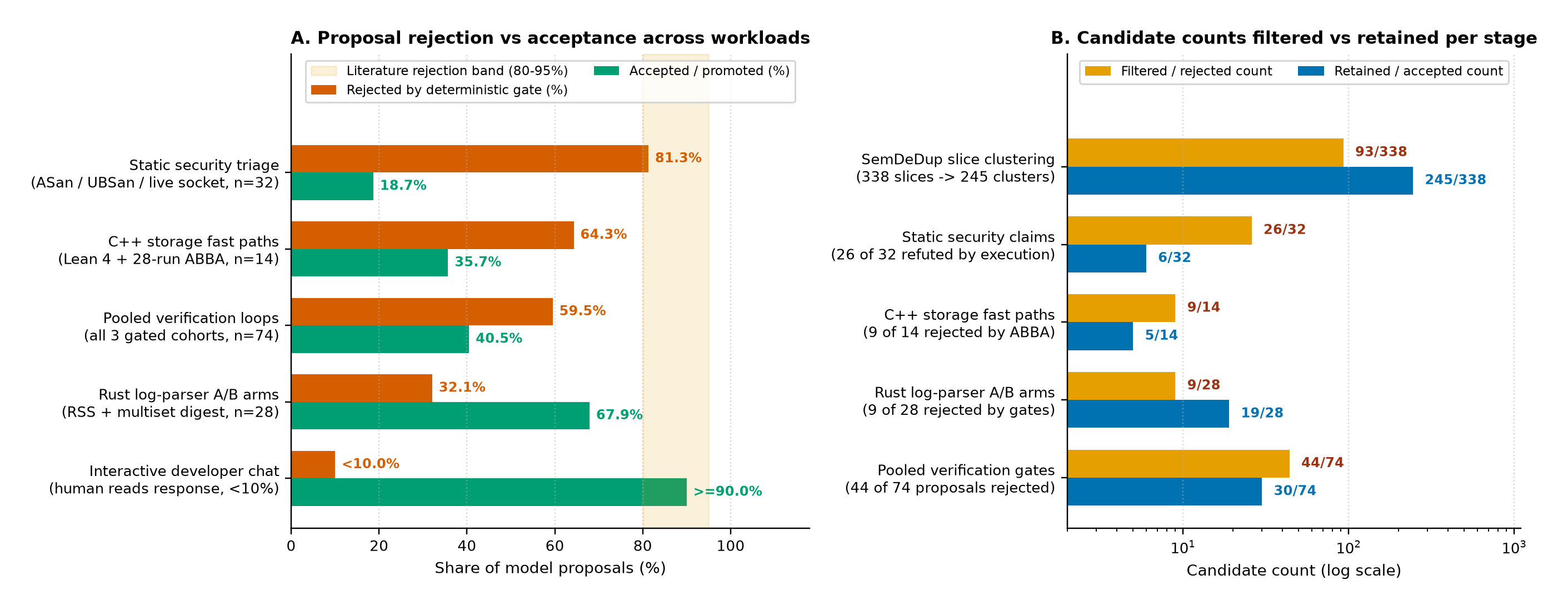
80.0%to95.0%rejection). In background verification loops, deterministic gates reject80.0%to95.0%of model proposals (Snell et al., 2024; Brown et al., 2024; Lin et al., 2025). In our security loop, deterministic gates rejected 81.3% (26of32) of high-confidence static security claims. In our C++ storage lab, hardware gates rejected 64.3% (9of14) of Lean-verified fast-path candidates (report 08). In our Rust log parser, benchmark gates rejected 32.1% (9of28) of optimization arms (report 06).
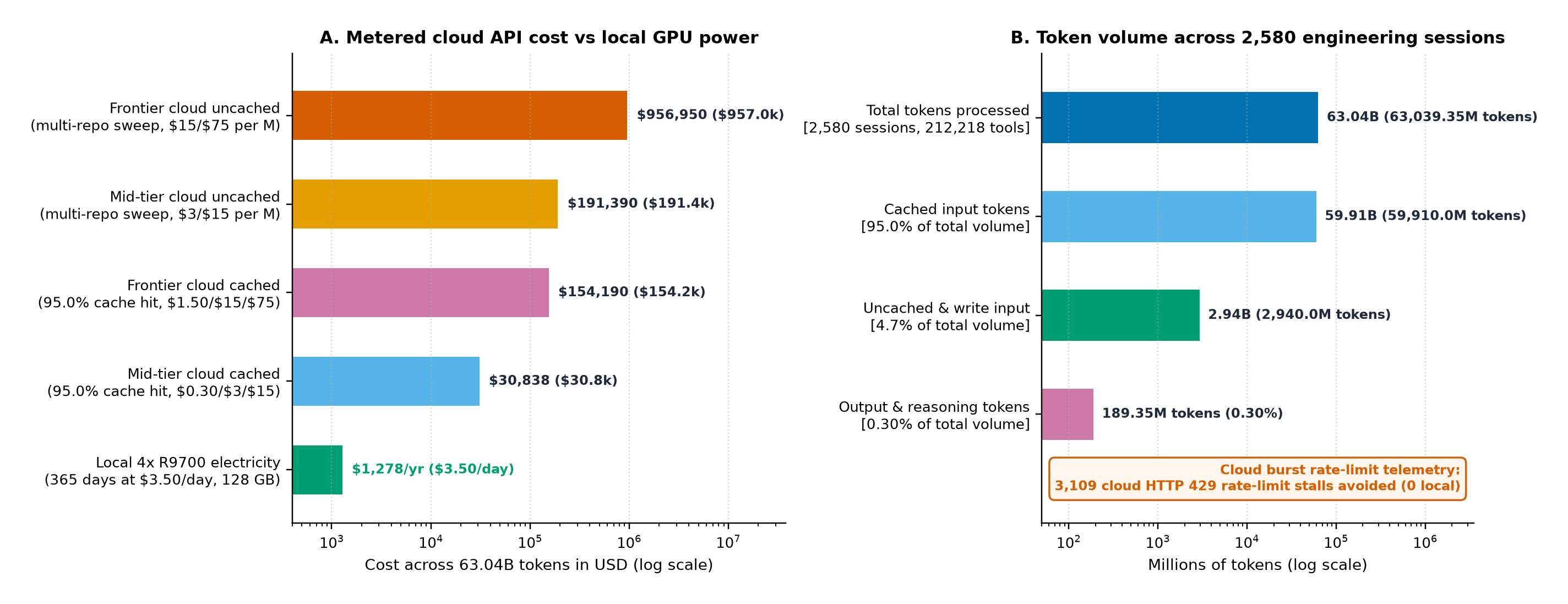
Paying per-token API rates when a compiler, sanitizer, or hardware benchmark discards most candidates taxes verification. Across 2,580 engineering sessions and 212,218 tool executions, our workflows processed 63.04 billion tokens. That volume comprised 59.91 billion cached input, 2.94 billion uncached and cache-write input, and 189.35 million output and reasoning tokens. On metered cloud APIs, that volume represents $30,838 ($30.8k) on mid-tier cached pricing to $154,190 ($154.2k) on frontier cached pricing. On uncached multi-repository sweeps, the same volume represents $191,390 ($191.4k) to $956,950 ($957.0k). Parallel cloud bursts also encountered 3,109 rate-limit (HTTP 429) events.
For high-rejection background loops over public codebases, synthetic fault harnesses, and compiler benchmarks, we run three models on 4 AMD Radeon AI PRO R9700 GPUs. Customer production telemetry never touches this local workstation. All customer support data stays inside regional enterprise cloud boundaries under our ISO/IEC 42001 (2023) controls (report 09 to report 11). The workstation provides 128 GB total VRAM ($3.50 per day or $1,278 per year in electricity) with 0 ms model-swap latency.
- A
4Bsingle-pass classifier (report 07,0output tokens,212to226ms over local HTTP,29.0ms kernel p50,4.48GB VRAM at 8-bit). - A
1,024-dimension embedding model (76.8ms per item for semantic deduplication at cosine threshold0.85,2.52GB VRAM, Abbas et al., 2023). - A
38Bcode-analysis model (1,305to3,184tokens/s prefill,57.7to165.3tokens/s decode,96.0GB VRAM with KV cache,0rate-limit stalls).
Because marginal token cost is near zero (Alcott, 2005; Ding et al., 2024; Narayan et al., 2025), engineers do not ration pre-release verification runs. We pair these internal verification gates with independent external ISO/IEC 42001 (2023) certification audits by an accredited third-party certification body.
Four rules for routing workloads between cloud APIs and local GPUs
- Keep low-rejection interactive reasoning on cached cloud APIs. When an engineer reads a warm-cache case briefing, prompt caching cuts cloud generation cost by 71.1% to 74.8% (report 04).
- Move high-rejection verifier loops to fixed-cost local GPUs. Deterministic gates reject 32.1% to 81.3% of our candidate proposals. Converting per-token OpEx into
$3.50/daylocal power removes the financial penalty on strict verification (Snell et al., 2024; Brown et al., 2024). - Filter and deduplicate locally before invoking deep code analysis. Our 4B classifier (
29.0ms p50) and 1,024-dimension clusterer (cos >= 0.85) collapse 338 slices into 245 clusters (-27.5%, Abbas et al., 2023). - Pin all pipeline stages co-resident in VRAM (
0model swaps). Allocating 103.0 GB across three models within 128.0 GB VRAM (leaving 25.0 GB for activation buffers) eliminates weight reloading across 24/7 sweeps.
Low-rejection chat vs high-rejection verification loops
Repeated sampling from small models beats single-shot calls when paired with a verifier (Brown et al., 2024; Snell et al., 2024; Shypula et al., 2024). However, verifier-guided search changes the unit economics of inference. In background "sleep-time" pipelines (Lin et al., 2025), the system generates many candidate patches, proofs, or exploit traces. A deterministic oracle then rejects every invalid branch.
| engineering workload | deterministic verifier oracle | evaluated proposals | rejected proposals | accepted proposals | rejection rate |
|---|---|---|---|---|---|
Static security triage (68 OSS repos) |
ASan, UBSan, go test, live socket harness |
32 |
26 |
6 |
81.3% (81.25%) |
| C++ storage fast paths (report 08) | 170 Lean 4 theorems + 28-run single-VM ABBA (+2.0% gate) |
14 |
9 |
5 |
64.3% (64.29%) |
| Rust log-parser A/B arms (report 06) | <= 1.10x peak RSS + 128-bit multiset digest (32 bundles) |
28 |
9 |
19 |
32.1% (32.14%) |
Pooled verification loops (3 cohorts) |
Sanitizer, theorem prover, or ABBA hardware gate |
74 |
44 |
30 |
59.5% (59.46%) |
SemDeDup pre-filter stage (cos >= 0.85) |
1,024-d L2 embedding cluster deduplication |
338 |
93 |
245 |
27.5% (27.51%) |
| Interactive developer chat (reference) | Human engineer reading response in session | n/a | n/a | n/a | <10.0% (>=90.0% read) |
Across three high-rejection verification loops (one open-source security audit and two internal systems labs), deterministic gates rejected 44 of 74 (59.5%) post-triage proposals.
- Security auditing (
81.3%rejection,26of32static claims). Standalone models suffer false-positive rates above 50.0% to 80.0% on static review because caller bounds live outside the local slice (Ullah et al., 2024). Across 68 repositories, our 4B gate and 1,024-dimensionSemDeDupstage reduced 338 hazard slices to 245 clusters (93removed,27.5%). Out of 32 high-confidence static claims escalated by the reasoning tier, compiled sanitizers (ASanandUBSan) and socket harnesses refuted 26 claims (81.3%). Only 6 claims (18.7%) from that cohort survived execution. - C++ storage fast-path optimization (
64.3%rejection,9of14candidates). In report 08, we evaluated 14 C++ storage fast-path candidates using 170 Lean 4 theorems and 36.0M to 251.9M fuzz checks. We then ran 28-run single-VMABBAhardware benchmarks. Even after formal equivalence proofs passed, hardware gates rejected 9 of 14 candidates (64.3%) that regressed on x86 or fell inside the2.0%noise floor. Only 5 candidates (35.7%) were promoted. - Rust log-parser optimization (
32.1%rejection,9of28arms). In report 06, we tested 28 pre-registered optimization arms on our Rust log-to-Parquet engine (currently being prepared for open-source release) across 32 bundles. Our1.10xpeak-RSS, liveness, and 128-bit multiset-equivalence gates rejected 9 of 28 arms (32.1%) and accepted 19 (67.9%).
Telemetry across 2,580 sessions, 63.04 billion tokens, and 3,109 rate-limit stalls
We audited token and rate-limit telemetry across 2,580 engineering sessions and 212,218 tool executions (82.3 tool calls per session on average). That ledger quantifies the cost of running iterative agent workflows on metered APIs versus local hardware.
| telemetry or cost metric | measured volume or unit rate | mid-tier cloud API | frontier cloud API | local 4x R9700 (128 GB) |
|---|---|---|---|---|
Total tokens processed (2,580 sessions) |
63.04B (63,039.35M tokens) |
63.04B tokens |
63.04B tokens |
63.04B tokens |
Cached input tokens (95.0% share) |
59.91B (59,910.0M tokens) |
$0.30 / 1M ($17,973) |
$1.50 / 1M ($89,865) |
$0.00 marginal |
Uncached input tokens (4.7% share) |
2.94B (2,940.0M tokens) |
$3.00 / 1M ($8,820) |
$15.00 / 1M ($44,100) |
$0.00 marginal |
Output & reasoning tokens (0.30% share) |
189.35M (0.19B tokens) |
$15.00 / 1M ($2,840) |
$75.00 / 1M ($14,201) |
$0.00 marginal |
Base token-row sum + 1.25x cache-write fee |
Base sum + cache-creation surcharge | $29,633 + $1,205 |
$148,166 + $6,024 |
$0.00 marginal |
Billed cached workload total (95.0% hit) |
59.91B cached + 2.94B uncached/write |
$30,838 ($30.8k) |
$154,190 ($154.2k) |
$1,278/yr power ($3,945/yr TCO, 7.8x-39.1x lower) |
Uncached multi-repo sweep cost (0% cache) |
62.85B uncached input + 189.35M output |
$191,390 ($191.4k) |
$956,950 ($957.0k) |
$1,278/yr power ($3,945/yr TCO, 48.5x-242.6x lower) |
Parallel burst rate-limit stalls (HTTP 429) |
212,218 tool executions |
3,109 stalls |
3,109 stalls |
0 stalls |
In Table 2, the base token rows sum to $29,633 on mid-tier cached pricing ($17,973 cached read, $8,820 uncached input, and $2,840 output). On frontier cached pricing, those base rows sum to $148,166 ($89,865 cached read, $44,100 uncached input, and $14,201 output). Adding the 1.25x cache-write creation surcharge (+$1,205 mid-tier and +$6,024 frontier) yields the billed totals of $30,838 and $154,190. Amortizing an $8,000 4-GPU workstation over 3 years adds $2,667/year in CapEx to $1,278/year in power ($3,945/year, or $10.81/day all-in TCO). That all-in TCO still cuts annual cost by 7.8x to 39.1x against cached cloud APIs and 48.5x to 242.6x against uncached sweeps.
Three operational findings emerged from the 63.04-billion-token ledger:
- Prefill dominates agentic verification (
99.70%input vs0.30%output). Across 212,218 tool calls, input tokens accounted for 99.70% of volume (59.91billion cached at95.0%plus2.94billion uncached at4.7%). Output and reasoning tokens accounted for only 189.35 million (0.30%). Verification loops read large codebases, AST slices, and sanitizer traces repeatedly while emitting compact verdicts or diffs. - Multi-repository sweeps break prompt-cache economics (
$30.8kvs$191.4k). In a single session, a 95.0% cache hit rate holds cost to $30,838 ($30.8k) on mid-tier and $154,190 ($154.2k) on frontier APIs. However, when a background daemon sweeps across 68 distinct repositories, context prefixes rotate continuously. Without warm prefix hits, sweeping 63.04 billion tokens costs $191,390 ($191.4k) on mid-tier APIs and $956,950 ($957.0k) on frontier APIs. That uncached cloud spend is149.8xto748.8xabove our$1,278annual local power cost. - Cloud rate-limit quotas (
3,109HTTP 429events) throttle parallel fan-out. When multi-worker audit harnesses burst across candidate slices concurrently, cloud endpoints enforce tokens-per-minute and requests-per-minute ceilings. Our telemetry recorded 3,109HTTP 429rate-limit stalls, whereas local GPUs executed parallel waves with 0 quota stalls.
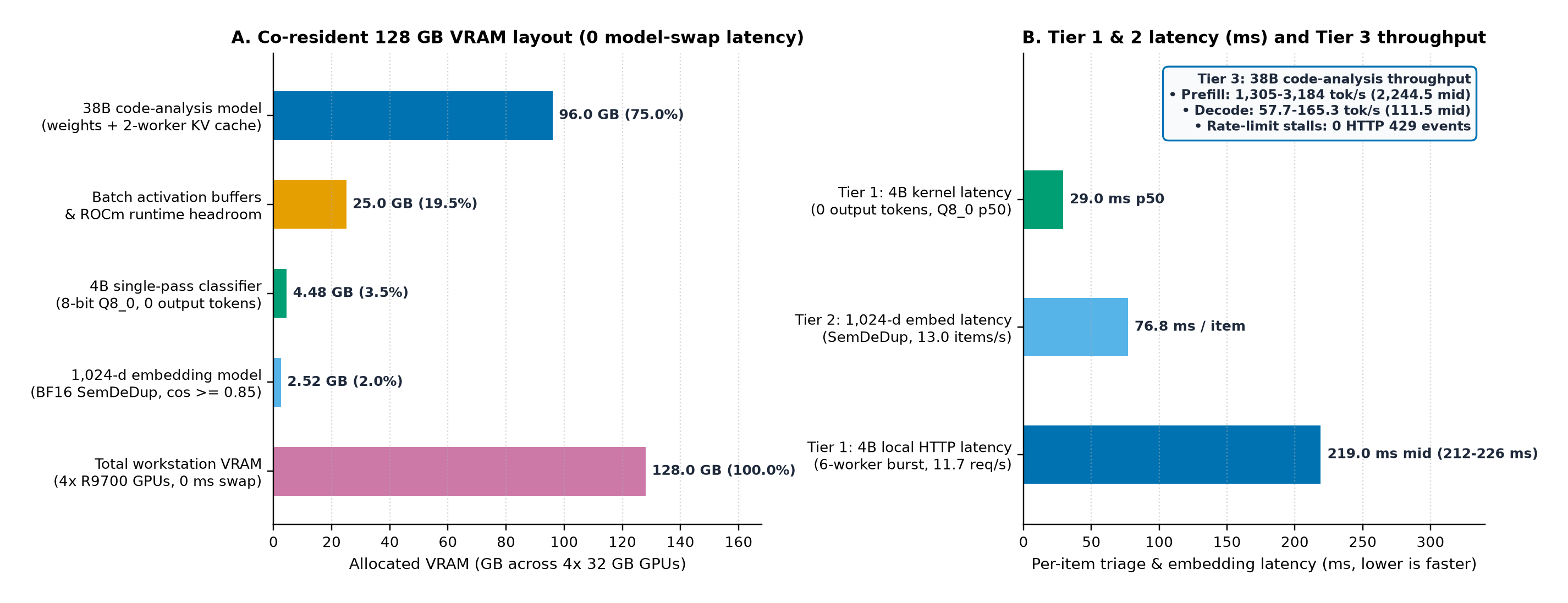
Co-resident 128 GB VRAM pipeline: 4B triage, 1,024-d SemDeDup, and 38B code analysis
Hybrid routing studies filter large contexts with small models first (Chen et al., 2023; Ding et al., 2024; Ong et al., 2024). In MinionS, local small models cut cloud spend by 5.7x while recovering 97.9% of frontier accuracy (Narayan et al., 2025).
To run that cascade continuously without per-token billing, we provision a local workstation with 4 AMD Radeon AI PRO R9700 GPUs (32 GB per GPU, 128.0 GB total VRAM). All three models stay pinned in VRAM simultaneously with 0 ms model-swap overhead.
| co-resident VRAM slice | precision & architecture | VRAM allocated (128.0 GB) |
VRAM share | measured latency or throughput | operational role in verification loop |
|---|---|---|---|---|---|
Tier 1: 4B single-pass classifier (report 07) |
8-bit Q8_0, 24 DeltaNet + 8 full-attention layers (32 total) |
4.48 GB |
3.5% |
29.0 ms kernel p50, 212-226 ms local HTTP (0 output tokens, 11.7 req/s) |
Unclamped 2-option choice triage (tau = 0.28), 4-class redaction, severity scoring |
Tier 2: 1,024-d embedding model (Abbas et al., 2023) |
16-bit BF16, 1,024-d L2-normalized dense encoder |
2.52 GB |
2.0% |
76.8 ms / item batched (13.0 items/s) |
SemDeDup cosine clustering (>= 0.85), cutting 338 slices to 245 clusters (-27.5%) |
Tier 3: 38B code-analysis model (2 workers) |
Multi-token prediction (61-85% draft accept), 2,048 / 4,096 max tokens |
96.00 GB |
75.0% |
1,305-3,184 tok/s prefill, 57.7-165.3 tok/s decode (0 HTTP 429 stalls) |
Cross-file caller/callee invariant tracing (Pass 1) and unified-diff patch synthesis (Pass 2) |
| Activation buffers & OS headroom | ROCm runtime, batch buffers, and pinned IPC memory | 25.00 GB |
19.5% |
0 ms model-swap overhead across 24/7 campaigns |
Prevents out-of-memory evictions during 6-way Tier 1 and 2-way Tier 3 bursts |
Each co-resident tier targets a specific bottleneck in the verification funnel:
- Tier 1 (
4Bsingle-pass classifier,4.48GB VRAM at 8-bitQ8_0). Qualified in report 07 and report 12, this model emits calibratedfloat32probabilities in one prefill pass (0output tokens, Kadavath et al., 2022). Local GPU kernel latency is 29.0 ms p50. Warm local HTTP latency across 6 concurrent workers is 212 to 226 ms (219.0ms midpoint,11.7requests/s burst). It scores candidate hazard slices via unclamped 2-optionchoicerouting (escalatevssuppressat threshold0.28) with symmetrized(A, B)and(B, A)runoff. - Tier 2 (
1,024-dimension embedding model,2.52GB VRAM atBF16). Parallel static slicers and fuzzers frequently surface the same defect pattern across multiple call sites. Before waking the 38B model, we embed each normalized slice header into a 1,024-dimension L2-normalized vector in 76.8 ms per item (13.0items/s). ApplyingSemDeDupclustering (Abbas et al., 2023) at a 0.85 cosine threshold collapsed 338 static slices into 245 unique clusters (eliminating 93 near-duplicates, or 27.5%). One exemplar per cluster advances with its multiplicity count attached. - Tier 3 (
38Bcode-analysis model,96.0GB VRAM with 2-worker KV cache). Because 99.70% of our tokens are input prefill, the 38B model's 1,305 to 3,184 tokens/s prefill speed (2,244.5midpoint) keeps cross-file analysis fast. Multi-token-prediction decode runs at 57.7 to 165.3 tokens/s (111.5midpoint,61%to85%draft acceptance). It operates in two passes:Pass 1(2,048max tokens) checks caller invariants to filter false positives, andPass 2(4,096max tokens) synthesizes minimal patches.
When marginal inference cost drops from $30.8k-$957.0k to $3.50/day in electricity, engineering behavior shifts. In resource economics, Jevons' paradox describes how lowering the unit cost of a resource expands total demand rather than merely saving money (Alcott, 2005). Under metered billing, teams ration multi-repository security sweeps and 10,000-seed fault-injection loops. On fixed-cost local GPUs, those verification loops run continuously (cutting test-time compute by 5.0x via offline pre-computation, Lin et al., 2025), and only verified proofs reach engineers.
Verification gates and methodology checks
- Token and rate-limit ledger audit (
2,580sessions,212,218tool calls). Verified that cached input (59.91B), uncached input (2.94B), and output (189.35M) tokens sum to63,039.35M(63.04B) tokens, with3,109loggedHTTP 429cloud rate-limit stalls. - Co-resident VRAM and zero-swap verification (
128.0GB across4GPUs). Verified that the 4B classifier (4.48GB), 1,024-d embedding model (2.52GB), and 38B model (96.0GB) remain resident simultaneously with0model-eviction swaps. - Prompt-Exclusion and unclamped
choiceguardrails (report 07). Verified that Tier 1 (4B) excludes raw line and commit frequencies from prompt text (fusing priors in log-odds space) and uses unclamped 2-optionchoicerouting (0output tokens). - Deterministic execution gate before human review (
74proposals across3loops). Verified that every escalated security claim, C++ patch, and Rust arm is gated by a sanitizer (ASan/UBSan), Lean 4 proof, orABBAbenchmark.
Infrastructure antipatterns rejected by our gates
- Justifying local models solely through data privacy. Zero Data Retention cloud contracts already cover many compliance paths. Local GPUs win primarily through near-zero marginal cost on
80%to95%rejection loops. - Running uncached multi-repository background sweeps on metered frontier APIs. Rotating across
68repositories invalidates prompt caches, turning a$30.8kcached workload into a$191.4kto$957.0kbill with3,109HTTP 429stalls. - Sending every raw static slice directly to a reasoning model without
SemDeDup. Skipping the29.0ms 4B classifier and76.8ms embedding stage wastes27.5%of 38B calls on duplicates (cos >= 0.85). - Time-sharing a single GPU by swapping model weights from disk. Reloading a
38Bmodel between triage and audit stages adds multi-second I/O stalls. Pinning all3models across128GB VRAM holds swap overhead at0ms. - Accepting unverified static model claims without an execution oracle. Rejected after sanitizers, Lean 4 proofs, and
ABBAgates refuted81.3%of security claims,64.3%of C++ patches, and32.1%of Rust arms.
Pressure tests
Every finding was checked against the six standing fronts in Methods.
| front | what was tested | result |
|---|---|---|
| Specification | Privacy-only local LLM framing vs high-rejection verifier-loop unit economics (32.1% to 81.3% rejection) |
Showed that even with ZDR cloud compliance (report 11), 59.5% pooled candidate rejection makes metered sweeps uneconomical |
| Aggregation | Total 63.04B token volume vs decomposed cached (59.91B), uncached (2.94B), and output (189.35M) tiers |
Exposed that 99.70% of tokens are input prefill and that multi-repo cache misses raise cloud cost from $30.8k-$154.2k to $191.4k-$957.0k |
| Adjustment coarseness | Raw static hazard slices (338) vs 4B choice triage (29.0 ms) + 1,024-d SemDeDup (cos >= 0.85, 76.8 ms) |
Removed 93 redundant slices (27.5% reduction to 245 clusters) before invoking the 38B code-analysis model |
| Prior work | Test-time scaling (Snell et al., 2024; Brown et al., 2024), sleep-time compute (Lin et al., 2025), and Jevons' paradox (Alcott, 2005) | Connected test-time verification scaling to fixed-CapEx local GPUs ($3.50/day), explaining why near-zero marginal cost expands verification coverage |
| Baseline sufficiency | Single-tier 38B or cloud-only auditing vs co-resident 3-model local pipeline + deterministic execution gates |
Execution gates filtered 26/32 (81.3%) static security false positives, 9/14 (64.3%) C++ patches, and 9/28 (32.1%) Rust arms with 0 HTTP 429 stalls |
| Cross-sectional units | Single workflow vs 3 distinct engineering loops (68-repo security triage, 14 C++ storage candidates, 28 Rust log-parser arms) |
Confirmed high candidate rejection across all three domains (81.3%, 64.3%, and 32.1%; 44/74 or 59.5% pooled) |
What this does not show
First, our local 4-GPU workstation processes only public open-source repositories, synthetic fault-injection inputs, and compiler benchmarks. Customer support tickets, diagnostic bundles, and production telemetry never run on unmanaged desktop GPUs. Customer data stays inside governed regional cloud boundaries (report 09 to report 11). Frontier cloud models also handle low-rejection incident synthesis (report 02, report 03).
Second, our $3.50 per day ($1,278 per year) operating figure measures electricity alone, before hardware depreciation. Amortizing an $8,000 4-GPU AMD Radeon AI PRO R9700 (128 GB VRAM) workstation over 3 years ($2,667/year CapEx plus $1,278/year power) gives $3,945/year ($10.81/day all-in TCO). Across 2,580 sessions (63.04B tokens), that all-in TCO still cuts annual cost by 7.8x to 39.1x against cached APIs (48.5x to 242.6x uncached).
Third, near-zero marginal token cost improves engineering quality only when paired with a deterministic verifier. Without compiled AddressSanitizer harnesses, Lean 4 proofs (report 08), or single-VM ABBA benchmarks (report 06), running local models 24/7 merely generates unverified code suggestions faster.
Reproduce
All metrics in this report and its three figures are stored in numbers.json, with SHA-256 integrity digests recorded in MANIFEST.md.
References
- Abbas, A., Tirumala, K., Simig, D., Ganguli, S., & Morcos, A. S. (2023). SemDeDup: Data-Efficient Learning at Web-Scale Through Semantic Deduplication. arXiv preprint. arXiv.
- Alcott, B. (2005). Jevons' Paradox. Ecological Economics. DOI.
- Brown, B., Juravsky, J., Ehrlich, R., Clark, R., Le, Q. V., Re, C., & Mirhoseini, A. (2024). Large Language Monkeys: Scaling Inference Compute with Repeated Sampling. arXiv preprint. arXiv.
- Chen, L., Zaharia, M., & Zou, J. (2023). FrugalGPT: How to Use Large Language Models While Reducing Cost and Improving Performance. arXiv preprint. arXiv.
- Ding, D., Mallick, A., Wang, C., Sim, R., Mukherjee, S., Ruhle, V., Lakshmanan, L. V. S., & Awadallah, A. H. (2024). Hybrid LLM: Cost-Efficient and Quality-Aware Query Routing. Proceedings of ICLR 2024. arXiv.
- ISO/IEC. (2023).
ISO/IEC 42001(2023): Information Technology - Artificial Intelligence - Management System. International Organization for Standardization. - Kadavath, S., Conerly, T., Askell, A., Henighan, T., Drain, D., Perez, E., et al. (2022). Language Models (Mostly) Know What They Know. arXiv preprint. arXiv.
- Lin, K., Snell, C., Wang, Y., Packer, C., Wooders, S., Stoica, I., & Gonzalez, J. E. (2025). Sleep-Time Compute: Beyond Inference Scaling at Test-Time. arXiv preprint. arXiv.
- Narayan, A., Biderman, D., Eyuboglu, S., May, A., Linderman, S., Zou, J., & Re, C. (2025). Minions: Cost-Efficient Collaboration Between On-Device and Cloud Language Models. arXiv preprint. arXiv.
- Ong, I., Almahairi, A., Wu, V., Chiang, W.-L., Wu, T., Gonzalez, J. E., Kadous, M. W., & Stoica, I. (2024). RouteLLM: Learning to Route LLMs with Preference Data. arXiv preprint. arXiv.
- Shypula, A., Madaan, A., Zeng, Y., Alon, U., Gardner, J., Hashemi, M., Neubig, G., Ranganathan, P., Bastani, O., & Yazdanbakhsh, A. (2024). Learning Performance-Improving Code Edits. Proceedings of ICLR 2024. arXiv.
- Snell, C., Lee, J., Xu, K., & Kumar, A. (2024). Scaling LLM Test-Time Compute Optimally Can Be More Effective than Scaling Model Parameters. arXiv preprint. arXiv.
- Ullah, S., Han, M., Pujar, S., Pearce, H., Coskun, A., & Stringhini, G. (2024). LLMs Cannot Reliably Identify and Reason About Security Vulnerabilities (Yet?). Proceedings of IEEE Symposium on Security and Privacy (S&P 2024). arXiv.