Implementing ISO/IEC 42001 for production AI systems: governance, risk, and lifecycle controls
- Published
- Data
- 38 Annex A controls, 5 additional controls, 104 verification checkpoints, 304 RACI cells, 7 repositories
- Figures
- 4
The claim
Most enterprise AI governance programs fail in one of two ways. Some teams claim a blanket exemption because they call hosted foundation models through a cloud API. Other teams write static policy binders that drift away from production code within weeks.
ISO/IEC 42001 (2023) is the international standard for artificial intelligence management systems (Clauses 4 to 10 and 38 controls across 9 Annex A objectives). In Europe, it pairs with the EU AI Act (Regulation (EU) 2024/1689) and EN 18286 (2026), the harmonised quality management standard for Article 17. Putting these standards into practice requires turning policy clauses into automated checks and database rules (Brundage et al., 2020; Raji et al., 2020).
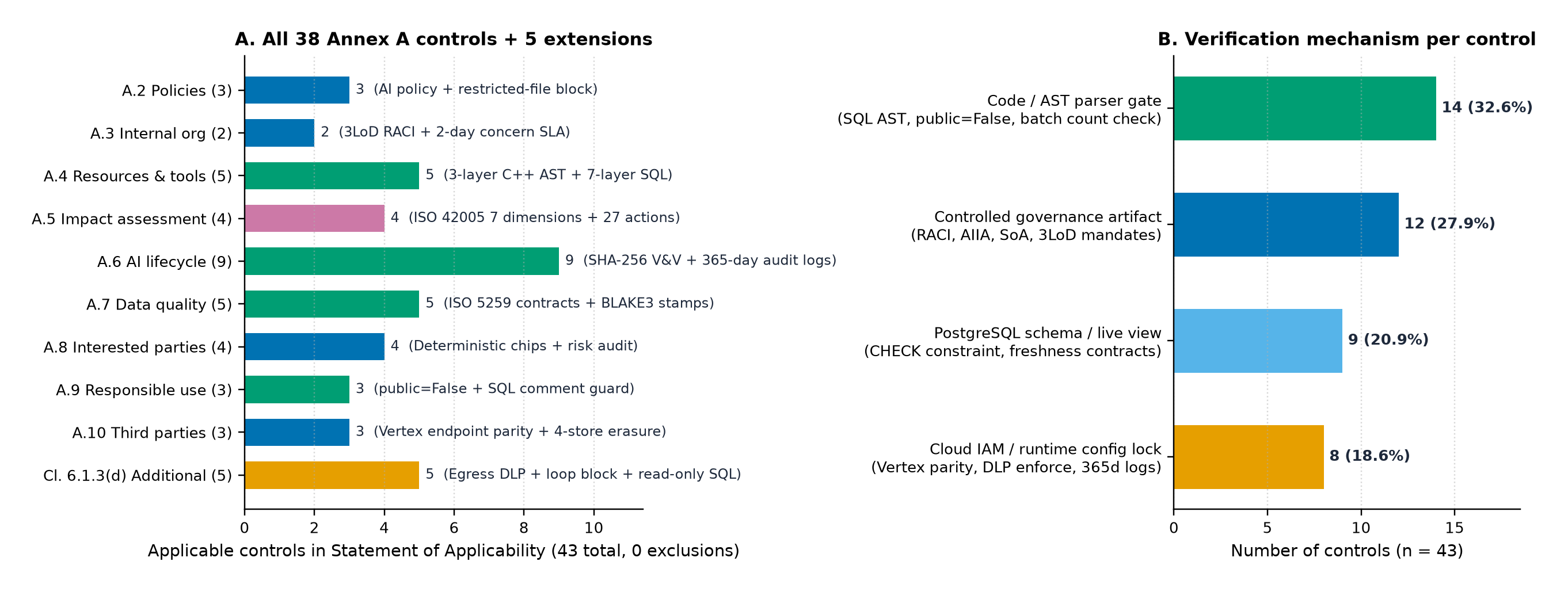
Over the past year, we implemented an AI management system across 7 production repositories. The system governs 39 single-task agents, 53 Model Context Protocol (MCP) tools, and 14 retrieval connectors (4.31M indexed chunks). Our Statement of Applicability covers all 38 Annex A controls with 0 exclusions, plus 5 additional controls under Clause 6.1.3(d) (43 total controls).
We take AI governance seriously enough to subject our systems, code, and processes to independent external ISO/IEC 42001 (2023) certification audits by an accredited third-party auditor. Any leader deploying AI in enterprise operations should pair internal automated gates with independent external audits. Before our readiness walkthrough, we audited 104 control claims directly against our production repositories and live cloud configuration. We mapped accountability across 38 lifecycle activities and 8 roles (304 cells), guaranteeing a single accountable owner per row (100%) and 0 self-audit overlaps. We also moved control tracking into PostgreSQL, where a database constraint blocks any active control that lacks an evidence link.
This three-part series offers a practical blueprint for leaders implementing ISO/IEC 42001 (2023) in regulated industries. Part 1 covers scoping, role separation, impact assessment (ISO/IEC 42005 (2025)), the EU AI Act crosswalk, and database-backed compliance tracking. Part 2 covers Annex A.4 and A.7, focusing on SQL tool sandboxing, data quality (ISO/IEC 5259-1 (2024)), and output redaction. Part 3 covers Clause 8 and Annex A.6, A.8, A.9, and A.10, focusing on pre-deployment gates, human oversight, and incident containment.
Four governance controls to implement first
- Scope your prompts, retrieval pipelines, and tools as an AI producer. Under
ISO/IEC 42001(2023)Clause 4.1, calling a hosted model API makes you a deployer only for the base model weights. Because you build and control your retrieval pipelines (14connectors) and agent tools (53MCP tools), all 38 Annex A controls remain applicable. - Validate your RACI matrix in continuous integration, not in a static spreadsheet. Our automated check verifies 304 role assignments across 38 lifecycle activities. It guarantees that 38 of 38 activities have exactly 1 Accountable role (
A), at least 1 Responsible role (R), and 0 self-audit overlaps. - Check safety test suites with a syntax-tree import linter. When engineers or coding assistants write compliance tests, they sometimes assert against local mock stubs without importing production code. Our
<50ms Python syntax-tree check blocks any safety test file that does not import and call the production package. - Track compliance status in a relational database with
CHECKconstraints. Store control attestation in PostgreSQL with an append-only history trigger and aCHECKconstraint requiring a non-empty evidence URL. No control can be marked met or partial without a verifiable link to code or logs.
Clause 4 and the producer-deployer boundary
Under Clause 4.1, an organization must determine its role (AI producer, provider, deployer, or partner per ISO/IEC 22989) before defining its scope (Clause 4.3). In enterprise AI, teams often assume that using Google Vertex AI, AWS Bedrock, or Azure OpenAI exempts them from Annex A lifecycle and data controls.
That exemption applies only to foundation-model pre-training. Teams that build retrieval pipelines, agent tools, and system prompts are the AI producer of that compound system (Mökander et al., 2023). In our deployment, we operate 14 retrieval connectors and 53 MCP tools. Our Statement of Applicability therefore includes all 38 Annex A controls (0 exclusions) plus 5 additional engineering controls (43 total).
| Annex A group or clause extension | normative controls | exclusions | primary verification mechanism |
|---|---|---|---|
A.2 Policies related to AI (A.2.2 to A.2.4) |
3 | 0 | AI policy bound to security crosswalk and restricted-file ingestion block |
A.3 Internal organization (A.3.2 to A.3.3) |
2 | 0 | Three-line-of-defense RACI (304 cells) and concern log (2-day intake SLA) |
A.4 Resources for AI systems (A.4.2 to A.4.6) |
5 | 0 | Asset inventory, 3-layer C++ AST SQL sandbox, and 7-layer read-only database role |
A.5 Assessing impacts of AI (A.5.2 to A.5.5) |
4 | 0 | Impact assessment (ISO/IEC 42005 (2025)), 7 dimensions, 6 triggers, and 27 actions |
A.6 AI system life cycle (A.6.1.2 to A.6.2.8) |
9 | 0 | Pre-registered SHA-256 evaluation index, AST test linter, and 365-day audit logs |
A.7 Data for AI systems (A.7.2 to A.7.6) |
5 | 0 | Data quality rules (ISO/IEC 5259-1 (2024)), BLAKE3 hashes, and 37 SQL freshness contracts |
A.8 Information for parties (A.8.2 to A.8.5) |
4 | 0 | Operator guide (7 epistemic limits), deterministic badges, and audited risk responses |
A.9 Use of AI systems (A.9.2 to A.9.4) |
3 | 0 | Hardcoded public=False across 7 publishers and live SQL public-comment monitor |
A.10 Third-party & customer (A.10.2 to A.10.4) |
3 | 0 | Cloud endpoint vector-space parity and 4-store customer deletion runbook |
Clause 6.1.3(d) extensions (Additional controls 1 to 5) |
5 | 0 | 2-layer egress DLP (4 paths), pre-prompt redaction, corpus loop exclusion, dump block, and read-only SQL role |
| Total in Statement of Applicability | 43 | 0 | 14 code/AST gates, 12 controlled specs, 9 SQL views/constraints, 8 cloud/IAM locks |
Under Clause 4.2, an organization must also map its interested parties and legal obligations. Our register covers 15 parties (8 internal roles and 7 external stakeholders) and 6 binding reporting obligations. External stakeholders include enterprise customers, cloud model providers, and certification auditors.
Clause 4.2 directly affects regulatory classification under the EU AI Act (Regulation (EU) 2024/1689). Annex III section 4(b) classifies AI systems used to monitor or evaluate worker performance as High-Risk. Many companies inadvertently cross this line when they build dashboards tracking how often individual employees accept AI suggestions. To keep an internal copilot outside Annex III section 4(b) by design, the telemetry schema should prohibit per-employee usage or acceptance leaderboards. Our operational views aggregate at the team queue level and suppress any cell with fewer than 5 observations (n < 5, and n < 10 on resolution-time curves).
Clause 5 and Annex A.3: enforcing Three Lines of Defense
In fast-moving AI teams, the same engineering leader often designs the architecture, approves pull requests, accepts residual risk, and signs internal audits. Under ISO/IEC 42001 (2023) Clause 5.3 and Annex A.3.2, that concentration breaks segregation of duties.
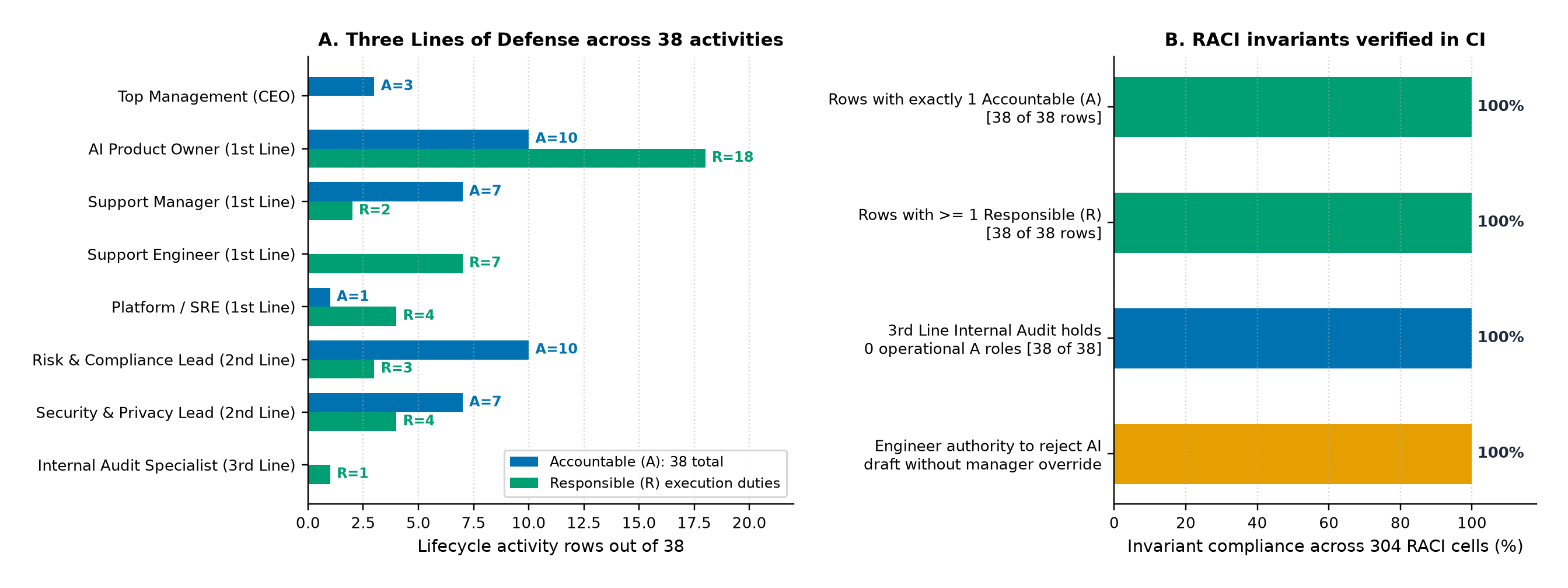
To scale governance cleanly in any enterprise, structure accountability around the Three Lines of Defense model. We mapped 38 lifecycle activities across 8 roles (304 cells), with Top Management assigned to the Chief Executive Officer (A = 3, R = 0).
- First Line (
4operational roles). It spans the AI Product Owner (A = 10, R = 16), Support Manager (A = 7, R = 2), Support Engineer (A = 0, R = 7), and Platform / SRE (A = 1, R = 4). These roles build, run, and review the system day to day. - Second Line (
2risk and security roles). The Risk and Compliance Lead (A = 10, R = 3) and Security and Privacy Lead (A = 7, R = 4) own risk criteria, security gates, and pre-deployment compliance sign-off. - Third Line (
1independent assurance role). The Internal Audit Specialist (A = 0, R = 1) plans and executesClause 9.2audits, reporting directly to Top Management and the risk council.
Rather than maintaining the RACI matrix by hand, we validate it with a Python script in continuous integration. The script checks four structural rules across all 304 cells.
- Single point of accountability (
38of38rows,100%). Every lifecycle activity has exactly 1 role marked Accountable (A). - Execution coverage (
38of38rows,100%). Every lifecycle activity has at least 1 role marked Responsible (R). - Zero self-audit overlap (
0overlaps). On the internal audit activity (Clause 9.2), accountability sits with Top Management and execution sits with internal audit. The AI engineering owner is strictly an auditee, never the approver. - Explicit lifecycle gate tags (
10gated rows,4stage tags). Ten key lifecycle gate rows carry explicit stage-gate qualifiers (pre-ingestion,pre-deployment,runtime oversight, orassurance) so teams know when sign-off is required.
Two organizational rules make those role assignments effective in practice:
- Protected human override authority (
A.3.2andA.9.2). Role mandates grant every reviewing engineer explicit authority to edit, reject, or discard any AI draft. The policy states that a manager cannot override an engineer's decision to reject an AI output. - Two-route concern reporting (
A.3.3). Engineers report operational AI defects in a dedicated intake channel with a 2-working-day SLA and a 3-year retention log. If a concern involves AI leadership or governance itself, the operator guide routes it directly to Second-Line GRC. Role competence (Clause 7.2) is structured around a 5-module training curriculum and 11 technical enablement sessions (with formal attendance and competency sign-off tracked for Stage 2).
Clause 6 and Annex A.5: impact assessment (ISO/IEC 42005) and risk triggers
In Clause 6.1, the standard separates AI risk assessment (6.1.2, guided by ISO/IEC 23894 (2023)) from AI system impact assessment (6.1.4, guided by ISO/IEC 42005 (2025)). Risk assessment evaluates threats to organizational objectives. Impact assessment evaluates consequences for individuals, groups, and society under intended use and foreseeable misuse (Parasuraman & Manzey, 2010; Sculley et al., 2015).
We evaluated 9 data sources and 3 personal-data categories (customer staff identifiers, employee identifiers in call recordings, and host/IP identifiers). Across those sources, we rated 7 impact dimensions before and after applying 11 privacy and safety controls.
- Privacy and data security (
Highinherent,Highcurrent residual,Mediumtarget). Operational logs and tickets often contain credentials and personal data. We block 4 classes of sensitive files (.sqldumps,.hprofheap dumps,.pemkeys, and.envfiles) at ingestion. We also enforce 2-layer output redaction across all 4 of 4 egress paths, while completing pre-ingestion redaction and configuration-code locks toward aMediumtarget. - Safety, reliability, and robustness (
Highinherent,Mediumresidual). Across our multi-model benchmarks (report 01 and report 02), frontier models remain confidently wrong on up to 12.7% of complex cases. We mitigate this by hardcodingpublic=Falseacross all 7 external publishing paths (0unclassified public comments over90days). We also replace model self-confidence with deterministic evidence badges (report 03). - Transparency and explainability (
Mediuminherent,Mediumresidual). Our operator guide documents 7 explicit epistemic limits and labels correlated ensemble draws (same model family). Every finding links to a reproducible query or log line. - Organisational resilience (
Mediuminherent,Mediumresidual). Under AnnexA.4.6, an honest assessment must also evaluate engineering continuity, cross-training, and operational handover coverage across core services. - Environmental and compute efficiency (
Mediuminherent,Lowresidual). Median input tokens per investigation grew from 13.7k to 217.0k. We addressed that growth via explicit prompt caching (71.1%to74.8%cost reduction in report 04) and 74.2x to 88.4x log compression (report 06). - Fairness and non-discrimination (
Lowinherent,Lowresidual). The system diagnoses infrastructure telemetry rather than consumer credit, hiring, or biometric data, and enforces then < 5anti-leaderboard rule. - Human rights and societal impact (
Lowinherent,Lowresidual). All outputs remain internal drafts reviewed by qualified engineers before any external action.
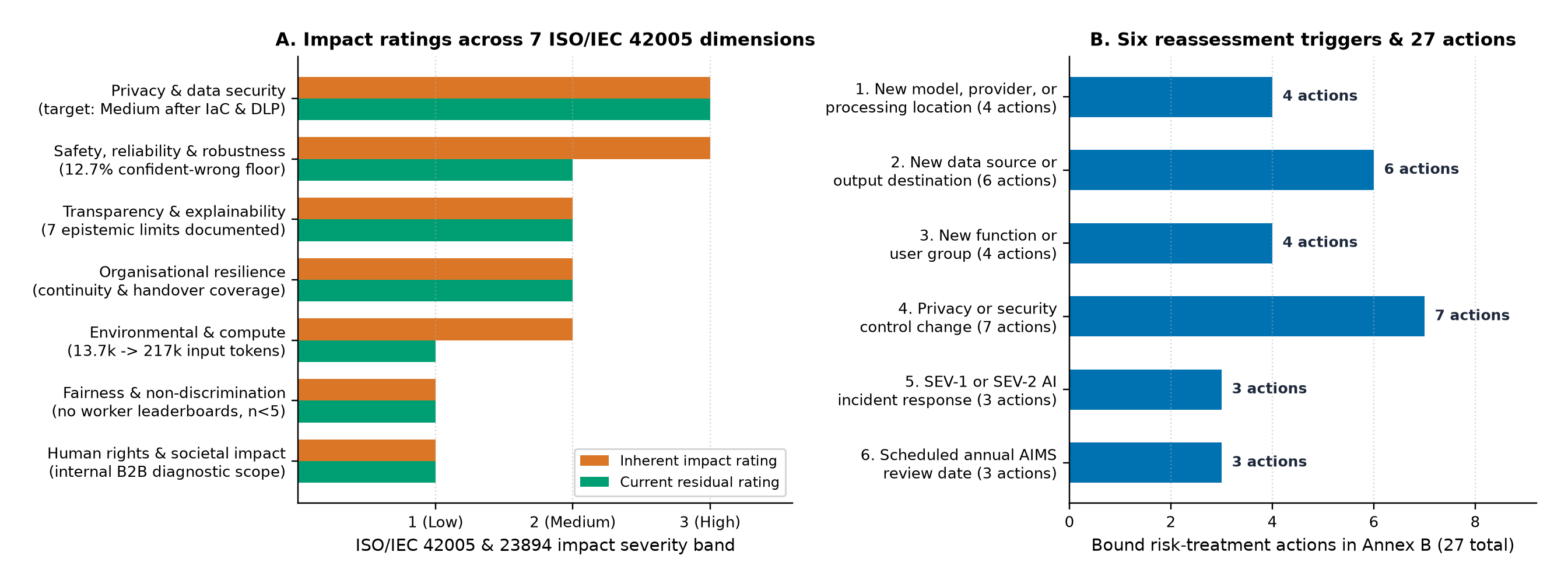
An impact assessment is useful only if engineering changes trigger it before deployment (Clause 8.4 and A.5.2). We embedded 6 mandatory reassessment triggers directly into our release and data-onboarding checklists. Reassessment is required before (1) a new model, provider, or processing location, (2) a new data source or output destination, or (3) a new function or user group. It is also required upon (4) a privacy or security control change, (5) a SEV-1 or SEV-2 AI incident, or (6) the annual review date. Annex B binds 27 tracked risk-treatment actions (A-01 to A-27) alongside 12 disclosed technical work items and 6 measurable AI objectives (Clause 6.2).
Crosswalk to the EU AI Act (2024/1689) and EN 18286 (2026)
For European organizations and global suppliers serving EU customers, ISO/IEC 42001 (2023) provides 70% to 80% of the management system required by the EU AI Act. On 2026-10-19, the European Commission cited EN 18286 (2026) in the Official Journal as the harmonised Quality Management System standard for Article 17. While ISO/IEC 42001 (2023) is organization-centric, EN 18286 (2026) (Annex C and Annex D) maps directly onto an ISO/IEC 42001 (2023) management system when paired with four companion standards.
EU AI Act (Regulation (EU) 2024/1689) |
statutory mandate | ISO/IEC 42001 (2023) clauses & controls |
companion standard & engineering control |
|---|---|---|---|
| Article 9 (Risk management system) | Iterative lifecycle risk analysis covering intended use, foreseeable misuse, and pre-release threshold testing | Clauses 6.1.2, 6.1.3, 8.2, 8.3; Annex A.5.2 to A.5.5, A.6.2.4 |
ISO/IEC 23894 (2023) & ISO/IEC 42005 (2025) + pre-registered SHA-256 gates |
| Article 10 (Data and data governance) | Provenance, preparation, quality metrics, and bias/completeness checks across datasets | Annex A.7.2 to A.7.6 and A.4.3 |
ISO/IEC 5259-1 (2024) to 5259-5 (2025) + BLAKE3 hashes & SQL freshness contracts |
| Article 12 (Record-keeping / logging) | Automatic lifetime event logging tracing inputs, reference stores, and human verifiers | Annex A.6.2.8, A.6.2.6, and Clause 7.5.3 |
EN 18286 (2026) Cl. 8/9 + 365-day cloud logs & hourly trace sync |
| Article 14 (Human oversight & automation bias) | HMI tools enabling operators to understand limits, counter automation bias (14(4)(b)), and override/halt |
Annex A.9.2 to A.9.4, A.8.2, and A.6.2.2 |
Parasuraman & Manzey (2010) + deterministic badges & public=False lock |
| Article 15 (Accuracy, robustness & cybersecurity) | Declared accuracy metrics, fault resilience, feedback-loop prevention, and prompt-injection defense | Annex A.6.2.4, A.6.2.6, A.4.4, A.2.3 |
3-layer C++ AST SQL sandbox, AI-note ingestion block, & blinded panels |
| Article 17 (Quality management system) | Documented QMS covering pre-determined change control, V&V, post-market monitoring, and incident reporting | Clauses 4 to 10; Annex A.2, A.3, A.6, A.7, A.8, A.10 |
EN 18286 (2026) Annex D crosswalk + versioned change register |
| Article 50 (Transparency obligations) | Clear disclosure of AI interaction and machine-readable provenance on generated outputs | Annex A.8.2, A.8.5, and A.9.2 to A.9.4 |
HTML oversight banner check & live SQL public-comment monitor |
Clauses 7, 9, and 10: preventing compliance drift with code audits and SQL constraints
The biggest operational risk in any governance program is compliance drift: policy documents claiming controls that do not match the running system. When teams use generative AI to draft compliance policies or tests, that drift accelerates. Left unchecked, early drafts can reference non-existent modules, overstate test coverage, or mark planned controls as operating.
Preparing for an independent external ISO/IEC 42001 (2023) certification audit by an accredited third-party auditor requires pairing external assurance with internal engineering gates. Four practices eliminate compliance drift across Clauses 7, 9, and 10.
1. Auditing every policy claim against production repositories (104 checkpoints)
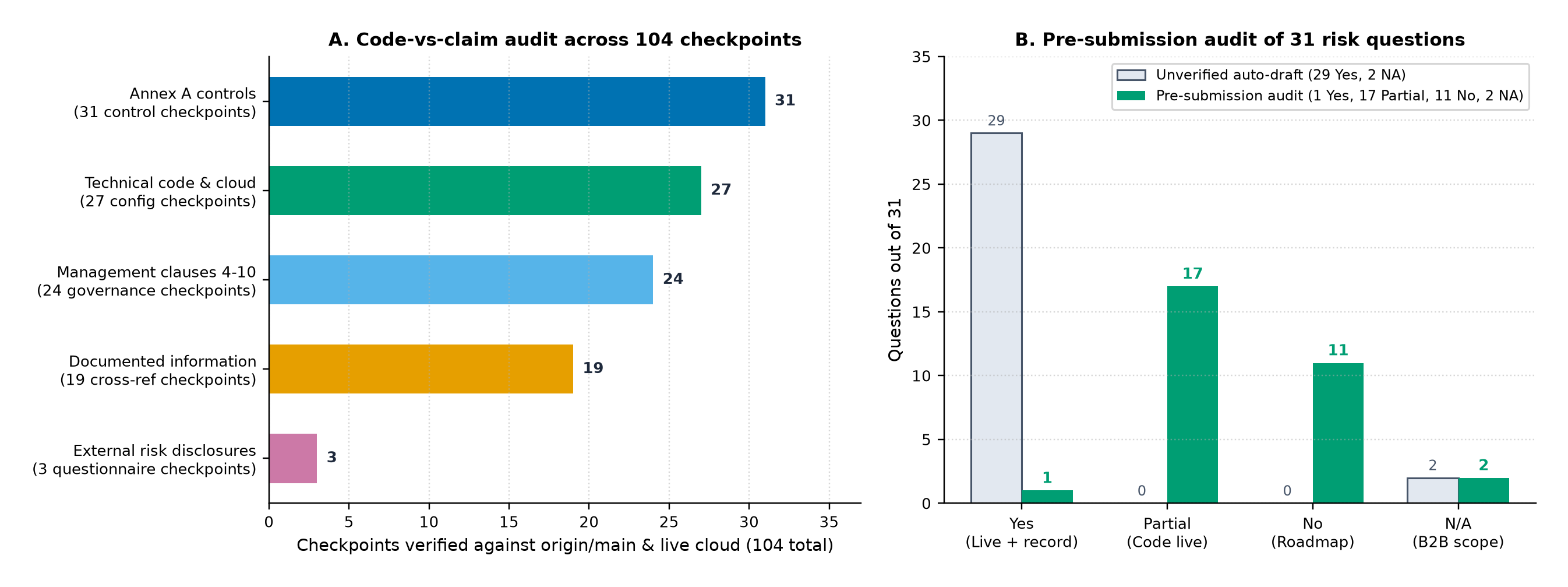
Before our readiness walkthrough, we audited 104 claims across our 14 governance documents against origin/main in all 7 repositories and live cloud settings. That audit ran across 8 tracks (4 repository layers and 4 control families).
The audit checked 31 Annex A controls, 27 technical configurations, 24 management clauses, 19 documentation cross-references, and 3 external risk disclosures. Every claim was graded by verification tier: directly verified in live cloud settings, verified by a committed file:line path, or unverified. Any unverified claim was downgraded to Partial or Planned. We also rewrote all 14 documents in plain language (<=20 words for procedures, <=25 words for descriptions). Our Git main branch serves as the single source of truth (Clause 7.5.3). Change history is tracked across 14 formal change records (8 contemporaneous and 6 retrospective records explicitly labeled as such).
2. Catching zero-import mock tests in <50 ms with syntax-tree linting
During that repository audit, we inspected an 8-function safety test suite. Two of the 8 test functions (25%) defined local mock helper functions inside the test file and asserted that those local helpers passed. They had zero imports from the production codebase. Standard test runners reported 100% green while testing the test file against itself.
To prevent mock tautologies in Python, we added a syntax-tree linter that checks every safety test file in under 50 ms. First, it verifies that the test module imports at least one symbol from the production packages. Second, it blocks any safety test that satisfies assertions solely through local mock stubs (catching 2 of 8 tautological functions and 8 of 8 mock-only files). By contrast, our production syntax-tree test parses all external publishing modules and verifies that every comment constructor sets public=False.
3. Pre-submission evidence-gating audit of enterprise risk questionnaires (31 questions)
Under Annex A.8.5 and A.10.4, enterprise customers evaluate AI vendors through Third-Party Risk Management (TPRM) questionnaires. Teams must never let an AI assistant auto-fill customer security questionnaires without code-and-record verification. We ran an internal pre-submission audit of a 31-question enterprise AI risk questionnaire prior to Legal and GRC release. An unverified auto-draft had marked 29 questions "Yes" and 2 "NA".
We applied a strict evidence rule across all 31 questions before release. Answering "Yes" requires both live code in production and a completed operational record. Answering "Partial" means the technical control is live in production while multi-quarter review records are completing. Under that rule, our pre-submission audit re-graded the 31 answers to 1 Yes, 17 Partial, 11 No, and 2 NA. We also attached a 31-row log citing the exact code path or remediation ticket for each item.
4. Storing control attestation and Clause 10.2 corrective actions in PostgreSQL
To keep governance state out of static spreadsheets, we store our control ledger and corrective actions (Clause 10.2 capa_id) in PostgreSQL.
CREATE TABLE IF NOT EXISTS governance_attestation (
    control_id      TEXT PRIMARY KEY,
    framework       TEXT NOT NULL,
    clause_ref      TEXT NOT NULL,
    control_title   TEXT NOT NULL,
    status          TEXT NOT NULL CHECK (status IN ('met', 'partial', 'gap', 'not_applicable')),
    owner_role      TEXT NOT NULL,
    evidence_url    TEXT,
    capa_id         TEXT,
    updated_at      TIMESTAMPTZ NOT NULL DEFAULT now(),
    CONSTRAINT governance_evidence_required
        CHECK (status NOT IN ('met', 'partial') OR (evidence_url IS NOT NULL AND length(trim(evidence_url)) > 0))
);
Three database rules keep this ledger honest under Clause 9.1 and Clause 10.2:
- Database rejection of unbacked claims (
governance_evidence_required). PostgreSQL rejects anyINSERTorUPDATEthat sets a control tometorpartialwithout a non-emptyevidence_url. - Append-only audit trail. A trigger logs every status, owner, evidence, or corrective-action (
capa_id) update into an immutable history table with actor and timestamp provenance. - Live SQL freshness and safety views (
37sources). Alongside the attestation table, SQL contracts monitor data age divided by expected cadence across 37 data, retrieval, and AI telemetry pipelines. A companion SQL view audits a 400-day window of ticket comments (confirming 0 unclassified automated public comments over the past 90 days). To satisfyClause 9.1valid-measurement rules, dashboard queries suppress cells withn < 10on resolution-time curves and exclude automated judge scores until human agreement reaches Cohen'skappa >= 0.6.
Verification gates and methodology checks
- Repository-wide claim audit (
104checkpoints). Every statement in our Statement of Applicability, impact assessment, and RACI matrix was checked againstorigin/mainacross all 7 repositories and live cloud settings. - Automated RACI invariant check (
304cells). Verified in CI that38of38lifecycle rows have a uniqueA,38of38have>=1R, and0rows assign operational accountability to internal audit. - Syntax-tree safety-test check (
<50ms). Verified that our AST linter catches2of8zero-import local mock functions and8of8standalone mock files while passing real AST checks on production code. - Database constraint enforcement. Verified that
governance_evidence_requiredblocks unlinkedmetorpartialrows and that unmerged branch features are explicitly recorded asstatus = 'gap'.
Governance antipatterns rejected by our gates
- Claiming a blanket deployer exemption for an agentic RAG platform. Rejected under
Clause 4.1(all 38 Annex A controls + 5 additional controls included with 0 exclusions). - Single-owner governance (
AI engineering leadacting as Top Management, approver, and internal auditor). Replaced by a 3-line-of-defense RACI matrix (CEOas Top Management, internal audit independent). - Zero-import mock safety tests (
2of8functions in an early test suite). Blocked by our<50ms Python syntax-tree import linter. - Citing offline research metrics (
0.69AUROC) as live CI gates. Replaced by 6 verified operational objectives (4of4output paths with Cloud DLP inenforcemode) and a 9.44-second pre-flight gate promoted for blocking CI enforcement. - Auto-filled
"Yes"responses on enterprise risk questionnaires (29of31rows). Caught by our internal pre-submission evidence-gating audit prior to Legal and GRC release and re-graded to1 Yes, 17 Partial, 11 No, 2 NA. - Per-employee AI usage leaderboards. Banned across all SQL views (
n < 5cell suppression) to prevent worker surveillance and EU AI Act Annex III section4(b)high-risk classification.
Pressure tests
Every finding was checked against the six standing fronts in Methods.
| front | what was tested | result |
|---|---|---|
| Specification | Blanket deployer exemption vs component-by-component producer/deployer boundary (Clause 4.1) |
Base LLM weights are supplier-provided (A.10.3); RAG (14 connectors) and MCP (53 tools) are producer-owned (0 exclusions) |
| Aggregation | Whole-binder "% compliant" claims vs per-control Implemented / Partial / Planned grading |
Replaced unverified "100%" claims with 2 Implemented, 32 Partial, 4 Planned in Annex A plus 5 Implemented extensions |
| Adjustment coarseness | Coarse single-line RACI vs 38-row x 8-role lifecycle matrix with 4 stage gate qualifiers | 304 cells verified in CI (100% unique A, 100% >=1 R, 0 self-audit overlaps) |
| Prior work | Internal algorithmic auditing (Raji et al., 2020), 3-layer LLM audits (Mökander et al., 2023), and verifiable claims (Brundage et al., 2020) | Operationalized via ISO/IEC 42001 (2023), ISO/IEC 42005 (2025), EN 18286 (2026), and PostgreSQL CHECK constraints |
| Baseline sufficiency | Standard test-runner pass status vs syntax-tree production-import check | Standard runner passed 2 of 8 zero-import mock tautologies; AST linter caught 100% in <50 ms |
| Cross-sectional units | Small-sample dashboard cells and uncalibrated LLM judge telemetry (Clause 9.1) |
Enforced n < 5 (activity) and n < 10 (survival) SQL suppression and excluded judge scores until human kappa >= 0.6 |
What this does not show
Implementing an ISO/IEC 42001 (2023) management system and passing a repository-wide engineering audit is distinct from completing a multi-month external Stage 2 certification audit. In our Statement of Applicability, 2 Annex A controls and all 5 additional controls are marked Implemented (7 total with both live controls and multi-cycle records). Thirty-two Annex A controls are marked Partial (technical control live in production while formal Clause 9.2 and Clause 9.3 review cycles complete), and 4 are Planned.
Second, ISO/IEC 42001 (2023) is an organization-level management standard. Under the EU AI Act (Regulation (EU) 2024/1689), legal presumption of conformity under Article 40 requires pairing ISO/IEC 42001 (2023) with the product-lifecycle quality management requirements of EN 18286 (2026).
Reproduce
All aggregate metrics in this report and its four figures are published in numbers.json, with SHA-256 file digests recorded in MANIFEST.md.
References
- Breck, E., Polyzotis, N., Roy, S., Whang, S., & Zinkevich, M. (2019). Data Validation for Machine Learning. Proceedings of MLSys 2019.
- Brundage, M., Avin, S., Wang, J., Belfield, H., Krueger, G., Hadfield, G., et al. (2020). Toward Trustworthy AI Development: Mechanisms for Supporting Verifiable Claims. arXiv preprint. arXiv.
- CEN/CENELEC. (2026).
EN 18286(prEN 18286): Artificial Intelligence - Quality Management System for EU AI Act Regulatory Purposes. European Committee for Standardization. - European Parliament & Council of the European Union. (2024). Regulation (EU)
2024/1689Laying Down Harmonised Rules on Artificial Intelligence (Artificial Intelligence Act). Official Journal of the European Union. - ISO/IEC. (2023a).
ISO/IEC 23894(2023): Information Technology - Artificial Intelligence - Guidance on Risk Management. International Organization for Standardization. - ISO/IEC. (2023b).
ISO/IEC 42001(2023): Information Technology - Artificial Intelligence - Management System. International Organization for Standardization. - ISO/IEC. (2024).
ISO/IEC 5259-1(2024) to5259-5(2025): Artificial Intelligence - Data Quality for Analytics and Machine Learning (ML), Parts 1 to 5. International Organization for Standardization. - ISO/IEC. (2025).
ISO/IEC 42005(2025): Information Technology - Artificial Intelligence (AI) - AI System Impact Assessment. International Organization for Standardization. - Mökander, J., Schuett, J., Kirk, H. R., & Floridi, L. (2023). Auditing Large Language Models: A Three-Layered Approach. AI and Ethics. DOI.
- Parasuraman, R., & Manzey, D. H. (2010). Complacency and Bias in Human Use of Automation: An Attentional Integration. Human Factors. DOI.
- Raji, I. D., Smart, A., White, R. N., Mitchell, M., Gebru, T., Hutchinson, B., et al. (2020). Closing the AI Accountability Gap: Defining an End-to-End Framework for Internal Algorithmic Auditing. Proceedings of ACM FAT* 2020. DOI.
- Sculley, D., Holt, G., Golovin, D., Davydov, E., Phillips, T., Ebner, D., et al. (2015). Hidden Technical Debt in Machine Learning Systems. Proceedings of NeurIPS 2015.