Three places where we used Lean 4 alongside C++, Rust, and Python
- Published
- Data
- 9,623 lines of Lean 4, 264 theorems, 14 C++ storage candidates, 301 Rust C-ABI FFI checks, 5 repositories
- Figures
- 4
The claim
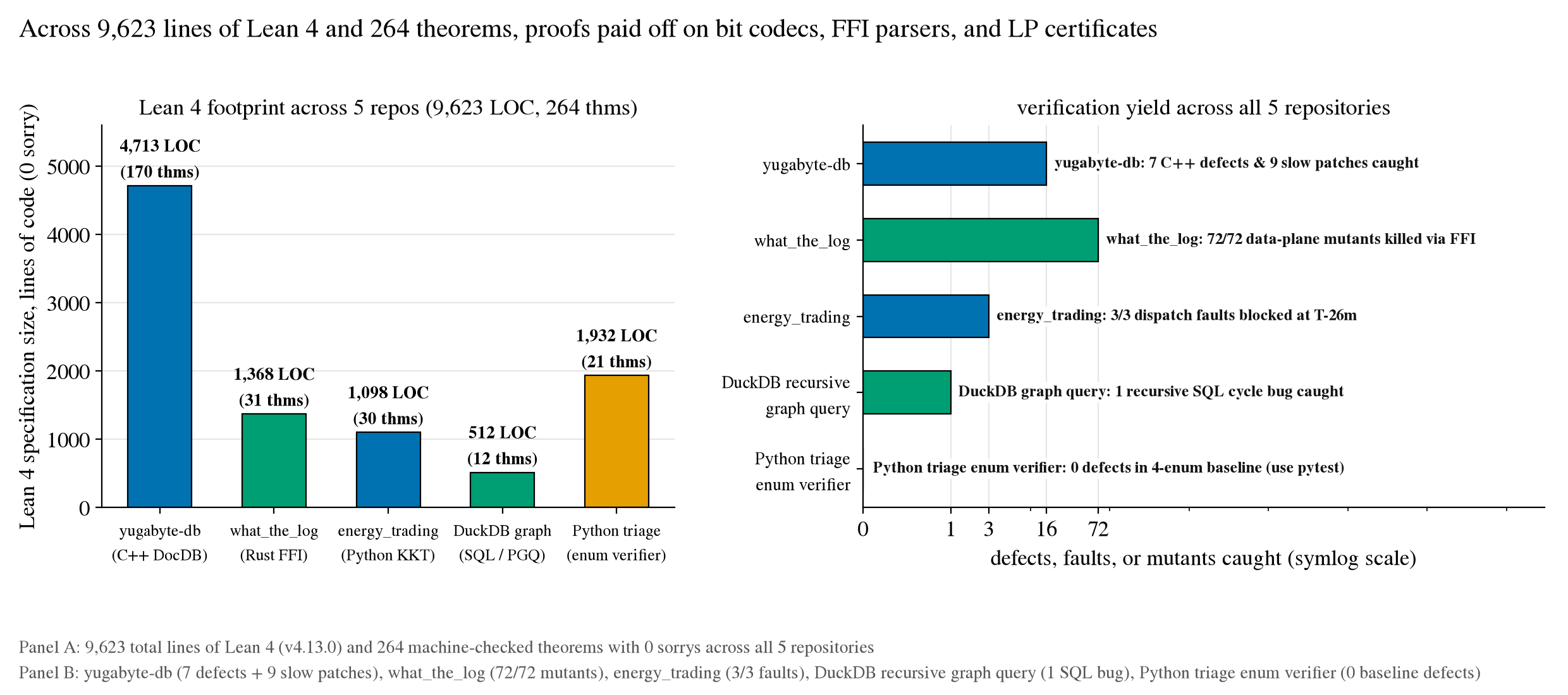
When an engineer or an AI assistant rewrites a parser, a storage codec, or an optimization solver, unit tests check only the inputs someone wrote. Over the past four months, we wrote 9,623 lines of Lean 4 (v4.13.0) across 5 repositories (de Moura & Ullrich, 2021). Those files contain 264 machine-checked theorems with 0 sorrys and 0 custom axioms.
Industrial formal verification succeeds when scoped to complex invariants rather than full compilers or finite lookup tables (Newcombe et al., 2015; Bornholt et al., 2021). Evaluating Lean 4 across five production and research repositories established our engineering boundary for where formal proofs outperform exhaustive unit tests.
Where Lean 4 paid off, it was never used alone. In C++ (yugabyte-db), we paired 170 Lean 4 theorems with 36.0M to 251.9M differential fuzz checks and 28-run single-VM ABBA benchmarks. In Rust (what_the_log), we compiled 1,368 lines of Lean 4 to C (libWTL.a) and called it directly from cargo test via extern "C" (Cutler et al., 2024). In Python (energy_trading_vidigais), we did not verify the linear-programming solver. Instead, we exported primal-dual Karush-Kuhn-Tucker (KKT) certificates as JSON and checked strong duality in Lean 4 (McConnell et al., 2011).
Across those three codebases and our 512-line DuckDB recursive graph query model, our proofs and harnesses caught 7 C++ defects and edge cases. Those 7 findings comprised 3 pre-merge candidate fast-path defects blocked in our performance lab and 4 boundary edge cases isolated by 251.9M-input fuzzing. They also caught 1 DuckDB recursive SQL cycle bug and blocked 3 energy-bid dispatch faults, while ABBA benchmarks rejected 9 slow C++ patches. By contrast, a 1,932-line Lean 4 Python triage enum verifier confirmed 0 defects in baseline and established our finite-enum ROI boundary.
I lead Applied AI and Support at Yugabyte. The yugabyte-db engine, what_the_log (report 06), the Python triage enum verifier (report 01), and the DuckDB recursive graph query belong to our operations stack. The European energy balancing prototype (energy_trading_vidigais) is a separate research project built with Antonio Vidigal (energy dashboard).
What to do before adding Lean 4 to a systems repo
- Bridge the model to the binary. A Lean 4 proof over a hand-transcribed function checks the transcription, not the C++ or Rust compiler. Link Lean via C-ABI FFI into
cargo test(@[export]), or pair the proof with a multi-million-input differential fuzzer (McKeeman, 1998). - Check solver certificates instead of verifying the solver. Do not formalize simplex or interior-point solvers in Lean. Export the primal allocation and dual multipliers, and check zero duality gap in 247 lines of Lean (McConnell et al., 2011; Pnueli et al., 1998).
- Never confuse mathematical equivalence with a speedup. A branchless
clzvarint patch (B1) passed 31 Lean theorems and 156.0M fuzz checks, gained +17.4% on ARM64, and lost -39.1% on AMD. - Skip Lean for small finite enums. If a rule checks a 4-value
Severityenum (P0toP3), an exhaustive 20-line Python test gives the same guarantee without maintaining two codebases.
Inventory across the five repositories
Every theorem across all 5 repositories compiles under leanprover/lean4:v4.13.0 with 0 sorrys and 0 custom axioms (#print axioms audited across 97 declarations in Audit.lean).
| repository and language | Lean 4 files | Lean 4 LOC | theorems (0 sorry) |
how it connects to production code | bugs or bad patches caught |
|---|---|---|---|---|---|
yugabyte-db (C++ RocksDB / DocDB) |
22 | 4,713 | 170 | 36.0M to 251.9M differential fuzz checks + 1.30M-key G2-v4 SHA-256 parity |
7 C++ defects (3 lab candidate bugs, 4 boundary edge cases) + 9 slow patches rejected |
what_the_log (Rust log lakehouse) |
6 | 1,368 | 31 | @[export] C-ABI static library (libWTL.a) called from cargo test (301 checks) |
72 of 72 semantic mutants killed |
energy_trading (Python LP / BESS) |
7 | 1,098 | 30 | JSON primal-dual KKT certificate checked at T-26 min (verify_bid_dispatch.py) |
3 adversarial bid faults blocked |
| DuckDB recursive graph query (SQL / PGQ) | 6 | 512 | 12 | native_decide counterexample + Python differential oracle (129 LOC) |
1 DuckDB INSTR cycle bug caught |
| Python triage enum verifier (4-value enums) | 9 | 1,932 | 21 | Duplicated in a 794-LOC Python Pydantic kernel over subprocess IPC | 0 defects in baseline (established finite-enum ROI boundary) |
| Total | 50 | 9,623 | 264 | n/a | n/a |
Pattern 1: C++ storage fast paths (yugabyte-db, 4,713 LOC, 170 theorems)
In October 2026, we ran a time-boxed cloud performance lab on yugabyte-db (main at c04597a6f88). We targeted RocksDB and DocDB read and seek hot paths (fast_varint.cc, doc_hybrid_time.cc, block.cc, cache.cc, skiplist.h).
To prevent subtle storage corruption, every candidate patch had to pass three gates.
- A zero-
sorryLean 4 proof. We wrote 4,192 lines and 157 theorems inPerfEquiv/(plus 438 LOC and 13 theorems in HLC.lean and LeaderLease.lean). Each module transcribes the baseline C++ function and the candidate fast path, proving observational equivalence. - Differential fuzzing (
36.0Mto251.9Minputs) andG2-v4database equivalence (1,299,104keys).G2-v4writes a fresh 126,324-key database per binary and cross-dumps both. It also reads a 1,000,000-key benchmark database and two 172,780-key frozen databases, requiring 100% SHA-256 hex-dump identity. - A step-isolation
ABBAwin of at least+2.0%(28runs per arm). One2-standard-32(pinned cores12to15), A/A noise floors were±1.26%onreadrandom,±0.10%onoverwrite, and±0.13%ondocdb-perf-test.
Five promoted C++ patches and nine rejected by hardware gates
Of 14 candidates evaluated, 5 passed all three gates and 9 were rejected or downgraded (cand15 promoted lab branch tip at 7a8f720b42).
| candidate and mechanism | Lean 4 LOC / theorems | step-isolation readrandom (28 runs/arm) |
other shapes or hardware SKU findings | verdict |
|---|---|---|---|---|
S18: 4x stall-hiding __builtin_prefetch (cache, FindPointer, restarts, BinarySeek) |
115 / 3 | +5.82% | seekrandom +4.07%, overwrite +0.53%; AMD t2d +4.19% |
Promoted |
S21: dual-branch skiplist prefetch + block front/trailer prefetch (Chen et al., 2007) |
166 / 5 | +6.99% | seekrandom +4.74%, overwrite +2.92%; AMD t2d seekrandom -2.05% |
Promoted |
S22: LRUHandle cache-line-0 packing (88 to 80 B) + next_hash prefetch |
194 / 5 | +11.17% | overwrite +4.12%; AMD Zen 3 (t2d) flipped to -2.14% reads |
Promoted (scoped to Intel) |
S29: DecodeRestartEntry shared == 0 fast path + S21 lookahead fix + Insert lock-hoist |
475 / 16 | +3.24% | seekrandom +1.77%; fixed S21 dead lookahead on fresh iterators |
Promoted |
S31: chain-slimming revert of S27 (LRUCache::Lookup lock-scope split) |
64 / 3 | +2.16% | +2.59% best; reverting S27 recovered its -1.56% loss |
Promoted |
cand15 promoted lab branch tip (S18+S21+S22+S23+S20+S24+S29, S27 reverted, S22 Intel-scoped) |
3,033 / 118 | +5.64% | seekrandom +5.00%, overwrite +2.96% vs pristine baseline |
Promoted lab branch tip |
B1: branchless clz varint length + fused negmask (FastVarInt.lean) |
452 / 31 | -12% to -17% | +17.4% ARM64, -39.1% AMD Zen 3 (t2d) (156.0M fuzz checks passed) |
Rejected |
Wave-1 (B2 + S15a + S15b): DocHybridTime fast path (DescOrder.lean + S15bFilter.lean) |
1,220 / 43 | +0.33% | 240.0M fuzz checks (200.0M clang + 40.0M UBSan); below +2.0% gate |
Rejected |
S20: write-batch DocRowwiseIterator reuse (S20T1Reuse.lean) |
113 / 5 | -0.80% | Pays only at >=20 SSTs (1.23x ratio); wash on low-SST DBs |
Downgraded |
S23 & S24: BloomHash memo (9 thms) & single-level IndexReader (14 thms) |
684 / 23 | +0.21% / +0.11% | Inside ±1.26% noise floor on 3-level SST index |
Downgraded |
S26: in-place secondary iterator update (TODO(index_iter), S26UpdateSecondaryIterator.lean) |
348 / 13 | -0.61% | tcmalloc size-cached delete + new beat pin-gating walk |
Rejected |
S27: LRUCache::Lookup lock-scope split (S27CacheLockScope.lean) |
224 / 10 | -1.56% | Extra state capture across split lock beat shorter hold time | Rejected & reverted |
S19 (expr cache, 1.12% CPU at 90% miss) & S25 (9.9% atomic CPU at 0 contention) |
n/a | n/a | 10 cache-mutex mechanisms rejected by profiling before coding |
Rejected at design |
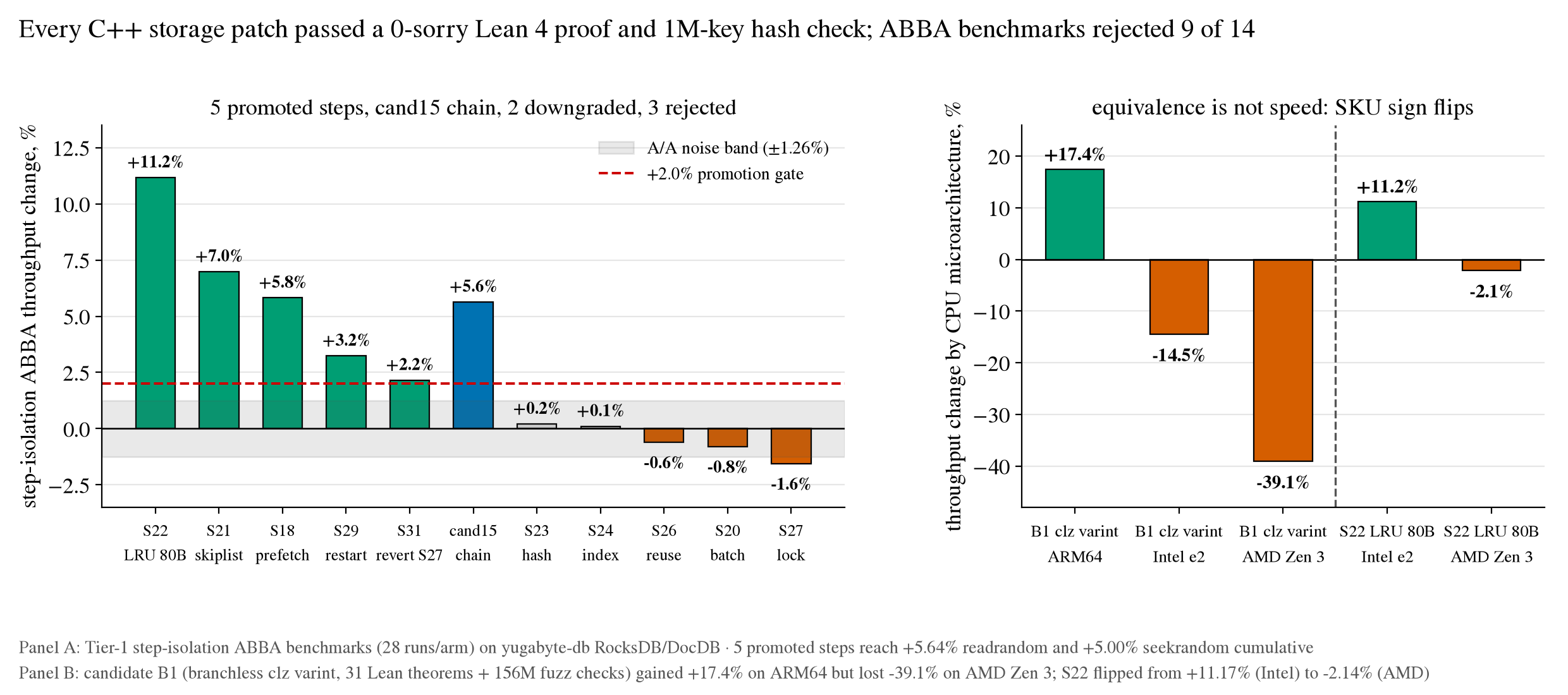
Two findings stood out from combining Lean 4 with ABBA hardware benchmarks:
- A proof of equivalence says nothing about instruction latency (
B1andS22). CandidateB1replaced the shift-and-count loop inFastVarIntwith__builtin_clzlland division by 7. We proved 31 theorems inFastVarInt.lean(452LOC) and ran 36.0M fuzz checks on macOS (+17.4%speedup on ARM64) plus 120.0M on Linux. On x86_64, theclz -> mulhi(/7)dependency chain lost to the branch predictor on short varints:-12.0%to-17.0%on Intele2(-14.5%midpoint) and-39.1%on AMD Zen 3 (t2d). RepackingLRUHandlefrom 88 to 80 bytes (S22, Kiriansky et al., 2016) won+11.17%on Intele2reads and+4.12%onoverwrite. On AMD Zen 3 (t2d),S22flipped to-2.14%(readrandom) and-2.31%(seekrandom) while gaining+1.54%onoverwrite. - Why component lenses beat distributed cluster benchmarks. On a 3-node RF=3 YSQL cluster (
t2d-standard-4across 3 zones), the A/A median noise floor was6.24%. That noise floor hidS21andS22(+0.53%to+1.25%end-to-end). ComponentABBAharnesses (±1.26%floor) are the only way to attribute storage-engine wins; the 3-node cluster test can only certify no regression.
Seven C++ defects and edge cases caught before production
Our Lean 4 models and differential harnesses exposed 3 pre-merge candidate fast-path defects in the lab and 4 boundary edge cases in existing code. All candidate-patch bugs were blocked prior to merge, all codec boundary checks were upstreamed, and zero customer production clusters were affected.
Pre-merge candidate fast-path defects blocked in the performance lab:
- Dead lookahead prefetch in candidate
S21(S29SeekDecodeAndInsertLock.lean). InBlockIter::Seek, candidateS21checkedif (current_ + 64 < restarts_)right afterMoveToRestartBlock(index). Formalizing the cursor state forS29proved thatMoveToRestartBlockupdatesNextEntryOffset()and leavescurrent_atrestarts_on fresh iterators (s29_fresh_iter_s21_lookahead_dead). ThusS21's lookahead was 100% dead onreadrandomand prefetched stale offsets on reusedseekrandomiterators (-2.05%AMDt2dregression). Anchoring onNextEntryOffset()inS29(s29_lookahead_targets_restart_offset) fixed the unshipped candidate (+3.24%). - Early-exit status initialization in candidate
S26(block.cc, proved inS26UpdateSecondaryIterator.lean). In the unshippedS26fast path, early-exitingBlock::NewIteratoron a corrupt block calledSetStatus()withoutInitialize(), leavingblock_entry_cache_stale (s26_set_status_only_leaves_stale). - Iterator pin-cleanup visibility in candidate
S26(iterator.h, proved inS26UpdateSecondaryIterator.lean). In the unshippedS26in-place iterator reuse patch,struct Cleanupname-hidCleanup(), leaking pinned block handles across reuses (s26_skipped_cleanup_leaks_pin).
Pre-existing boundary edge cases isolated by 251.9M-input fuzzing:
- Signed overflow boundary at
INT64_MIN(fast_varint.h).FastEncodeDescendingSignedVarIntnegatesv(-v), which is undefined behavior atv = INT64_MINin C++. Underclang++ -O2, it constant-folded toc0 00. Under-O2 -fwrapv(4failures in251,875,692fuzz checks),INT64_MINencoded to00 3f 7f ff..., reversing sort order at the extreme boundary. - Non-canonical trailer bit patterns (
doc_hybrid_time.cc). A 3.0M-pair differential probe uncovered50,295one's-complement-0alias pairs and209,499wrap pairs accepted withStatus::OK()while violating byte-order equivalence. - Rejected-insert metric counter (
cache.cc). Whenstrict_capacity_limit_rejected an insert (!s.ok()) inLRUCache::Insert, themetrics_->cache_usagegauge was incremented bychargewithout checkings.ok(). - Simultaneous fresh-cluster startup race (
ysql_catalog_config.cc). Startingyb-masterandyb-tserverat the exact same millisecond on a fresh RF=3 lab cluster triggered a startupCHECK(num_tablets > 0).
Pattern 2: linking Lean 4 into Rust's cargo test via C-ABI FFI (what_the_log, 1,368 LOC, 31 theorems)
In report 06, we described optimizing what_the_log (wtl), our 27.6k-line Rust log-to-Parquet engine (51,954 templates). To check that parallel optimizations never corrupt parsing, burst compression, or Bloom filters, we wrote a 1,368-line Lean 4 specification (formal_spec/WTL/, 31 theorems on disk).
Three core theorems anchor WTL/Proofs.lean (470 LOC):
- Linear parser step bound (
parser_termination_and_safety). For any input string $s$, the streaming glog parser terminates in at most $10|s| + 50$ steps without backtracking explosion. - Lossless burst conservation (
burst_compression_losslessandcompressEvents_conserves_count). Decompressing a temporal run-length burst (<= 60s span cap,60,000ms) recovers exactfirstTsandlastTsbounds and all 9 entity columns. It also preserves exact event counts (sum(repetition_count) = N). Across 4 production benchmarks (2.62billion total events), count conservation held with 0 discrepancies. That included2.44billion lines (532.8million bursts) on1.415TB BundleB14, and capping a63.1-hour burst onB17to60s. - Zero Bloom filter false negatives (
bloom_filter_zero_false_negatives). Verified across 98 production row groups (94.7%Bloom byte reduction in report 06) with 0 false negatives.
Compiling Lean 4 to libWTL.a (RustFFI.lean, 147 LOC)
Instead of assuming our Lean functions matched our Rust code, we used Lean 4's @[export] attribute in WTL/RustFFI.lean (6 exported C-ABI symbols). Lean's Perceus compiler (Reinking et al., 2021) compiles the specification into ~485 KiB of C (Proofs.lean erases to 9,298 bytes) and builds libWTL.a.
In wtl-v2/tests/lean_ffi_differential.rs, Rust's cargo test links libWTL.a via extern "C" (8-byte Lean object header plus 58 scalar bytes in #[repr(C)]). The test suite runs 301 live differential checks against the production Rust structs (0 divergences, Cutler et al., 2024). Those 301 checks cover 100 glog lines (80 valid and 20 malformed), 100 burst-merge scenarios, 100 Bloom hash probes, and 1 schema-v8 check.
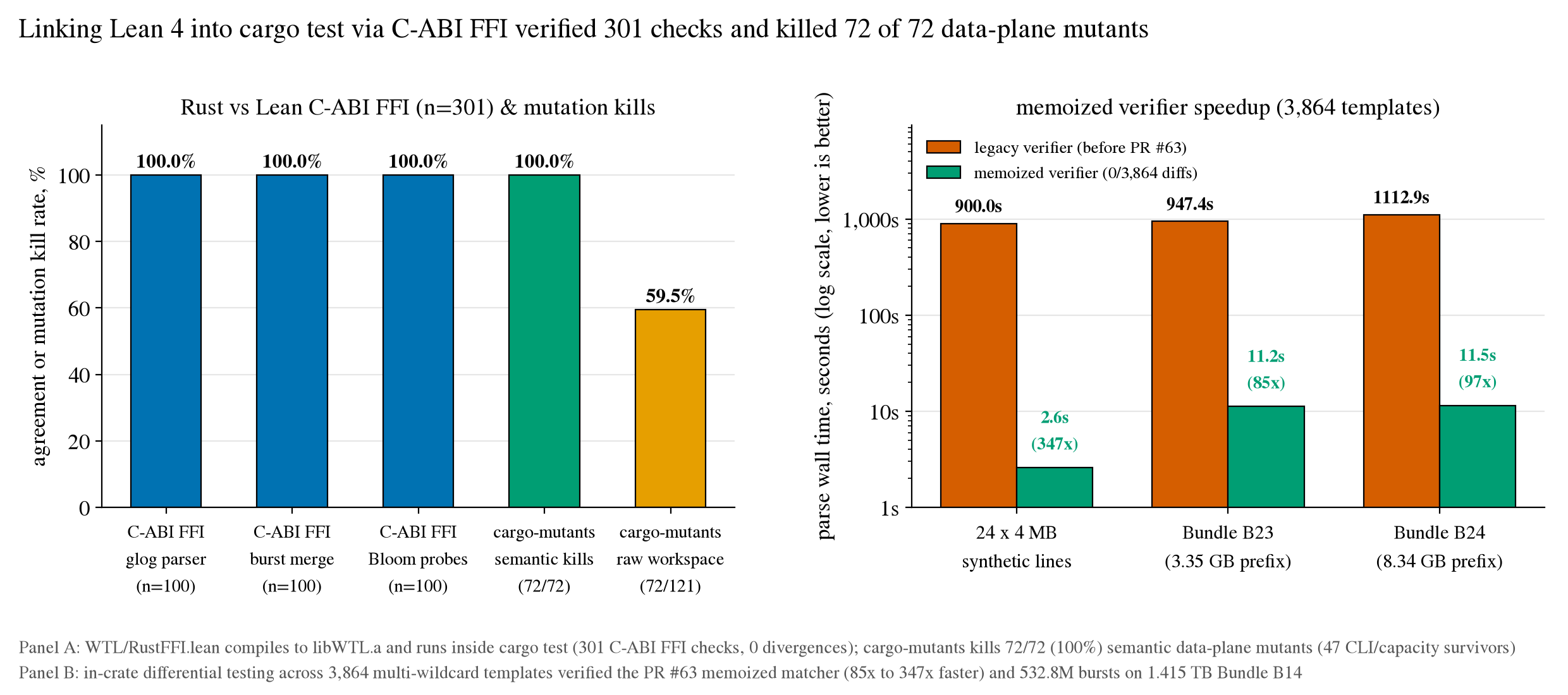
We also ran cargo-mutants (Jia & Harman, 2011) across the Rust workspace (794 unit tests, 121 total mutants). All 72 semantic data-plane mutants (parser offsets, burst bounds, and Bloom bitmasks) were killed (100.0%, plus 1 timeout kill and 1 unviable mutant). The 47 surviving mutants were CLI eprintln! strings and Vec::with_capacity hints (59.5% raw kill rate).
In-crate differential testing across 3,864 multi-wildcard templates also verified the PR #63 memoized verifier (0 divergences). Runtime on 24 x 4 MB synthetic lines fell from 900.0 s (SIGKILL) to 2.59 s (347x). Bundle B23 fell from 947.4 s to 11.2 s (85x), and Bundle B24 fell from 1,112.9 s to 11.5 s (97x).
Pattern 3: checking Python LP duality certificates before energy gate closure (energy_trading_vidigais, 1,098 LOC, 30 theorems)
In energy_trading_vidigais, our Python engine optimizes battery bids across 18 European PICASSO zones (15-minute Market Time Units, 4-second TSO cycles). Under European balancing rules, gate closure is at T-25 minutes before delivery (bid generation runs at T-30).
Verifying a numerical linear-programming solver (scipy / HiGHS) in Lean 4 would take years. Instead, we used the certifying algorithm pattern (McConnell et al., 2011; Pnueli et al., 1998). At T-26 minutes (1 minute before gate closure), a 433-line Python bridge (verify_bid_dispatch.py) exports the candidate dispatch as a JSON Karush-Kuhn-Tucker (KKT) certificate. Lean 4 checks that certificate across 1,098 LOC and 30 theorems (BalancingMarket.lean, MeritOrderProofs.lean, DualityCertificates.lean, and BatteryStateOfCharge.lean).
Lean 4 checks four decidable conditions in 2.28 seconds.
- Primal feasibility (
PrimalFeasible). Every allocation $x_i$ satisfies $0 \le x_i \le Q_i$ and $\sum x_i = D$. - Dual feasibility (
DualFeasible). Stationarity $c_i - \lambda + \mu_i - \nu_i = 0$ holds with $\mu_i, \nu_i \ge 0$. - Complementary slackness and EUR 0 duality gap (
primal_cost_eq_dual_objectiveandoptimality_certificate_guarantee). Primal cost $\sum c_i x_i$ equals dual objective $\lambda D - \sum \mu_i Q_i$. Both equalEUR 3,290on the65MW DE audit andEUR 3,400on the self-test (EUR 0gap), proving global optimality. - Multi-step battery State-of-Charge (
SoC) bounds (trajectory_preserves_invariant). Across a100MWh battery with a[10, 90]MWh safe envelope (10MWh minimum reserve floor), worst-case activation never underflows or overflows the pack.
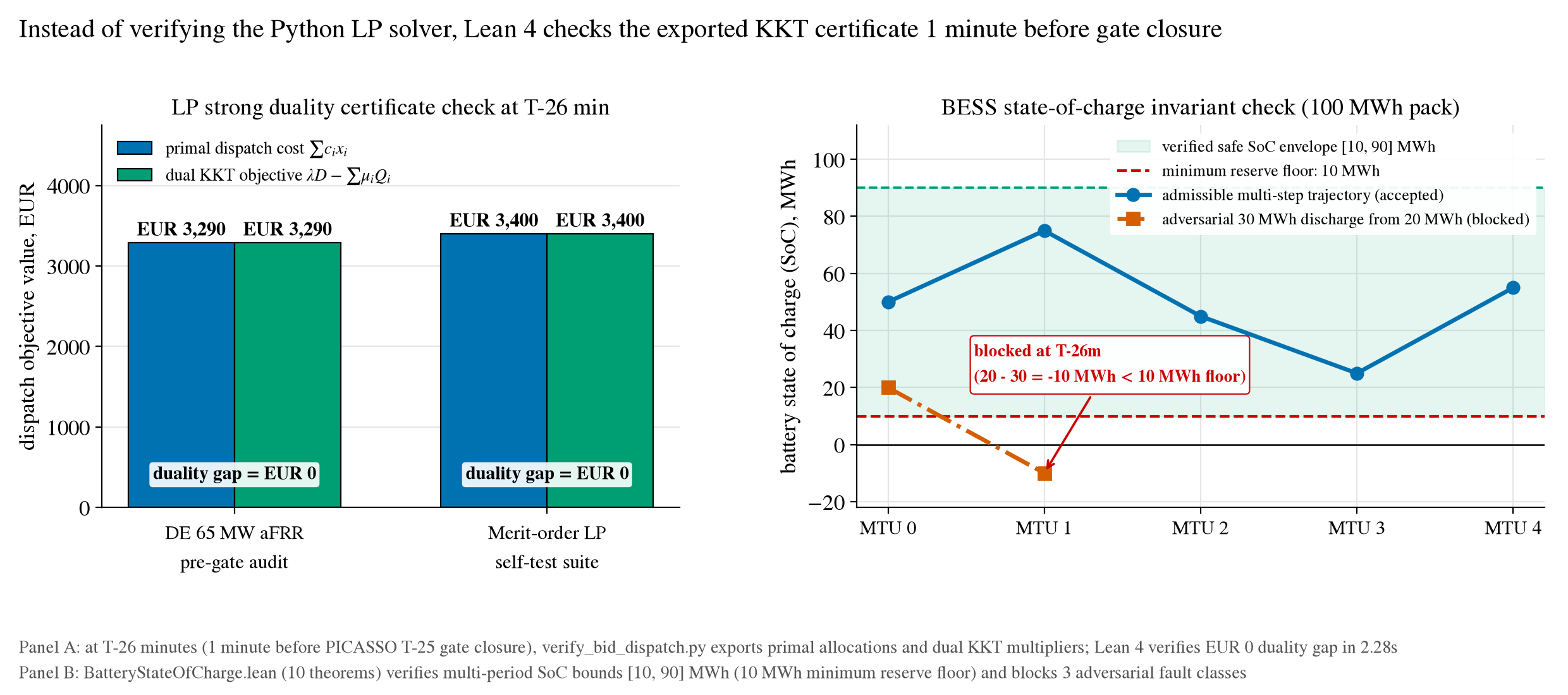
In our adversarial test suite, the Lean 4 gate blocked 3 of 3 injected dispatch faults before submission. It rejected an out-of-merit bid ladder (80 vs 40 EUR/MWh) and a 150 MW flow exceeding a 100 MW interconnector limit. It also blocked a 30 MWh discharge from 20 MWh (-10 MWh, below the 10 MWh floor).
Defining the ROI boundary: DuckDB recursive graph query vs Python triage enum verifier
Comparing our two smaller Lean 4 deployments defines the engineering boundary between high-return formalization and finite-domain testing.
- High-return (DuckDB recursive graph query,
512LOC,12theorems +129LOC Python oracle). InGraphTheory.lean, modeling our DuckDB recursive CTE organizational relationship graph query exposed a subtle cycle-detection flaw (naive_cycle_check_rejects_unvisited_node, proved bynative_decide). The SQL query checkedINSTR(p.path_str, e.source) = 0to prevent cycles. When"target_inc"was already in the path"target_inc -> ibm", the substring check falsely rejected organization"inc"as a cycle. We replacedINSTRwith discrete list membership (NOT list_contains, verified byset_cycle_check_sound). - Finite-enum ROI boundary (Python triage enum verifier,
1,932LOC,21theorems +794LOC duplicate Python kernel +451LOC tests). InGuardrails.leanandTicketTriage.lean, we formalized a 4-valueSeverityenum (P0toP3) and a 5-valueDeploymentTypeenum. Several theorems (quorum_loss_requires_p0,screen_url_implies_aeon_cloud) were 1-lineby rflproofs on lookup tables. The Lean proof confirmed 0 defects in our production severity and deployment lookup rules. Because production containers omit the Lean toolchain, mirroring all 1,932 lines of Lean required794lines in the Python verifier module. That result established our finite-enum ROI boundary and let us retire the duplicate 794-LOC Python subprocess kernel for exhaustivepytestCI checks (20lines).
Verification gates and methodology checks
- Testing whether a Lean proof guarantees C++ performance (
B1andS22).FastVarInt.lean(31theorems) and156.0Mfuzz checks provedB1100% equivalent to baseline, yetABBAbenchmarks rejected it (-12.0%to-17.0%Intel,-39.1%AMD Zen 3). Mathematical equivalence is orthogonal to pipeline stalls. - Testing raw SST file
sha256sum(G1) andldb dump(G2-v2). Raw SST file hashes failed on identical binaries due to background compaction races. Standardldb dump --dbsilently output 0 bytes on.sst.sblock.0sidecars, forcing us to build the1,299,104-keyG2-v4iterator dump gate. - Mutation testing the Rust + Lean FFI test suite (
cargo-mutants). Rather than trusting test count (794tests), we injected121mutants. All72semantic data-plane mutants were killed (100.0%), while47CLI logging and capacity-hint mutants survived. - Injecting invalid LP certificates (
verify_bid_dispatch.py). We tested non-monotone bid ladders (80vs40EUR/MWh), SoC underflow (-10MWh), and ATC overloads (150vs100MW) to confirm the Lean binary exits non-zero.
Candidates and designs rejected by our verification gates
- Nine Lean-verified C++ candidates. All 9 (
B1,Wave-1,S20,S23,S24,S26,S27,S19,S25) were rejected byABBAor Phase-0 hardware gates despite passing Lean 4 proofs. S21'scurrent_ + 64 < restarts_lookahead check: proved dead on fresh iterators inS29SeekDecodeAndInsertLock.leanand replaced withNextEntryOffset().- Using 3-node RF=3 distributed benchmarks (
6.24%A/A noise floor) to measure 2% to 6% storage patches. - DuckDB
INSTR(path_str, source) = 0cycle checking: disproved by counterexample inGraphTheory.lean. - Maintaining a duplicate 794-LOC Python subprocess kernel alongside 1,932 LOC of Lean 4 in the Python triage enum verifier. After the Lean proof confirmed 0 defects in the production lookup rules, we retired the duplicate kernel for direct exhaustive
pytestchecks in CI.
Pressure tests
Every finding was checked against the six standing fronts in Methods.
| front | what was tested | result |
|---|---|---|
| Specification | Lean functional transcription vs compiled C++/Rust binary semantics | Bridged by 156.0M to 251.9M C++ fuzz checks, 1.30M-key G2-v4 DB dumps, and 301 Rust extern "C" FFI calls |
| Aggregation | Cumulative chain benchmark (cand15 +5.64%) vs step-isolation ABBA lens |
Step-isolation caught S27 losing -1.56% inside the chain; reverting it in S31 gained +2.16% |
| Adjustment coarseness | Tier-1 single-VM db_bench (±1.26% floor) vs Tier-2 3-node RF=3 YSQL (6.24% floor) |
Tier-2 6.24% floor masked S21/S22 (+0.53% to +1.25%); Tier-1 ABBA required for attribution |
| Prior work | AWS Cedar Lean+Rust diff testing (Cutler et al., 2024), S3 lightweight specs (Bornholt et al., 2021), and certifying algorithms (McConnell et al., 2011) | Adopted directly; extended to C++ PerfEquiv + ABBA gating and PICASSO T-26 LP KKT certificates |
| Baseline sufficiency | cargo-mutants (121 mutants) on Rust FFI suite; 1,932-LOC Python triage enum verifier vs 20-line pytest check |
72/72 (100.0%) semantic mutants killed in wtl; Python triage enum verifier confirmed 0 defects in baseline (established finite-enum ROI boundary) |
| Cross-sectional units | Hardware SKU portability across ARM64, Intel e2, and AMD Zen 3 (t2d) (28 runs/arm) |
Exposed B1 (+17.4% ARM64 vs -39.1% AMD) and S22 (+11.17% Intel vs -2.14% AMD) SKU sign flips |
What this does not show
In yugabyte-db, the Lean 4 modules in PerfEquiv/ verify functional transcriptions of the C++ algorithms under explicit integer and byte-lane assumptions (T1 to T6 in FastVarInt.lean). They do not verify the raw C++ AST or clang++ machine code. Bridging that gap relies on the 36.0M to 251.9M differential fuzz runs and the 1,299,104-key G2-v4 database dumps.
In what_the_log, the C-ABI FFI differential suite runs 301 structured cases (100 glog, 100 burst, 100 Bloom, 1 schema). Marshaling String and CGlogPrefix across the Lean runtime boundary adds per-call overhead. High-volume equivalence over millions of lines runs through our in-crate Rust differential oracles (3,864 templates and 6.44M real lines) and 128-bit DuckDB multiset digests.
Finally, in energy_trading_vidigais, DualityCertificates.lean verifies exact integer KKT certificates (Int and Nat in EUR/MWh and MW) at T-26 minutes (2.28 s). Full multi-zone network flow with floating-point tolerances requires rational scaling before certificate export.
Reproduce
We are preparing our Rust log-to-Parquet workspace and its Lean 4 specification (formal_spec/) for open-source release under the Apache 2.0 license. Every number in this report and its four figures is recorded in numbers.json, with file integrity hashes listed in MANIFEST.md.
References
- Bornholt, J., Joshi, R., Astrauskas, V., Cully, B., Kragl, B., Markle, S., et al. (2021). Using Lightweight Formal Methods to Validate a Key-Value Storage Node in Amazon S3. Proceedings of ACM SOSP 2021. DOI.
- Chen, S., Ailamaki, A., Gibbons, P. B., & Mowry, T. C. (2007). Improving Hash Join Performance through Prefetching. ACM Transactions on Database Systems. DOI.
- Cutler, J. W., Disselkoen, C., Eline, A., He, S., Headley, K., Hicks, M., et al. (2024). Cedar: A New Language for Expressive, Fast, Safe, and Analyzable Authorization. Proceedings of the ACM on Programming Languages (OOPSLA 2024). DOI. arXiv.
- de Moura, L., & Ullrich, S. (2021). The Lean 4 Theorem Prover and Programming Language. Proceedings of CADE-28. DOI.
- Jia, Y., & Harman, M. (2011). An Analysis and Survey of the Development of Mutation Testing. IEEE Transactions on Software Engineering. DOI.
- Kiriansky, V., Zhang, Y., & Amarasinghe, S. (2016). Optimizing Indirect Memory References with milk. Proceedings of IEEE/ACM PACT 2016. DOI.
- McConnell, R. M., Mehlhorn, K., Näher, S., & Schweitzer, P. (2011). Certifying Algorithms. Computer Science Review. DOI.
- McKeeman, W. M. (1998). Differential Testing for Software. Digital Technical Journal.
- Newcombe, C., Rath, T., Zhang, F., Munteanu, B., Brooker, M., & Deardeuff, M. (2015). How Amazon Web Services Uses Formal Methods. Communications of the ACM. DOI.
- Pnueli, A., Siegel, M., & Singerman, E. (1998). Translation Validation. Proceedings of TACAS 1998. DOI.
- Reinking, A., Xie, N., de Moura, L., & Leijen, D. (2021). Perceus: Garbage Free Reference Counting with Reuse. Proceedings of ACM PLDI 2021. DOI.